By Jeffrey A. Rendall
The fact age won’t be an issue for 2028 presidential candidates shows it matters, indeed
One of many potentially interesting aspects of the getting-closer-all-the-time 2028 presidential election is the fact that nearly all of the candidates from both parties will be quite a bit younger than those of the past few election cycles.
As a result, age shouldn’t be an issue in 2028, which would present quite a contrast from the last few campaigns, where the top candidates from both factions were long past “normal” retirement age, or were nearing it.
Recall how Crooked Hillary Clinton, while younger than her main Democrat primary competitor (Crazy Eyed Bernie Sanders), was scrutinized for her state of health? Remember how Hill then took a fall during the 2016 campaign and couldn’t stop coughing?
And we’re not even going to mention Republican Bob Dole’s infamous plummet from the stump twenty years before in 1996.
Pundits need something to talk about, and a candidate’s longevity has been of particular interest in recent decades.
Will age resurface in 2028? In an article titled, “A youth movement is coming for the 2028 presidential election”, Christian Datoc reported at the Washington Examiner last week:
“Secretary of State Marco Rubio, Vice President JD Vance, Rep. Alexandria Ocasio-Cortez (D-NY), and Sen. Jon Ossoff (D-GA) are the odds-on favorites on both Kalshi and Polymarket to be the next president. The group has an average age of 43. In 2029, when that group would be sworn into office, the average age would climb to 45. Gov. Gavin Newsom (D-CA), who has the fifth-best odds on both prediction markets, is currently 58.
“Just one potential candidate would be a septuagenarian. Rahm Emanuel, the former U.S. House representative from Illinois, two-term mayor of Chicago, White House chief of staff for former President Barack Obama, and ambassador to Japan under Biden, would be 70 on Inauguration Day 2029…
“Furthermore, following a string of deaths and medical episodes suffered by members of Congress, there’s been a vociferous push to elect younger lawmakers on both sides of the aisle. A poll conducted by NPR this past spring found that 80% of respondents supported term limits for both the U.S. House and Senate. A similar number supported putting age caps on all elected officials, with 78% of Democrats and 83% of Republicans voicing support.”
Why stop at elected officials? How about imposing term/age limits on bureaucrats and other members of the so-called civil service? Wouldn’t the infusion of new blood into the various stagnant government bureaucracies assure better and more efficient work product for us citizens?
So, Americans want younger folks to step up. Far be it from me to question Datoc’s premise, but after having gone through a decade-and-a-half of the two oldest presidents in American history, everyone who comes forward in 2028 and in the future will seem like a spring chicken to the electorate by comparison.
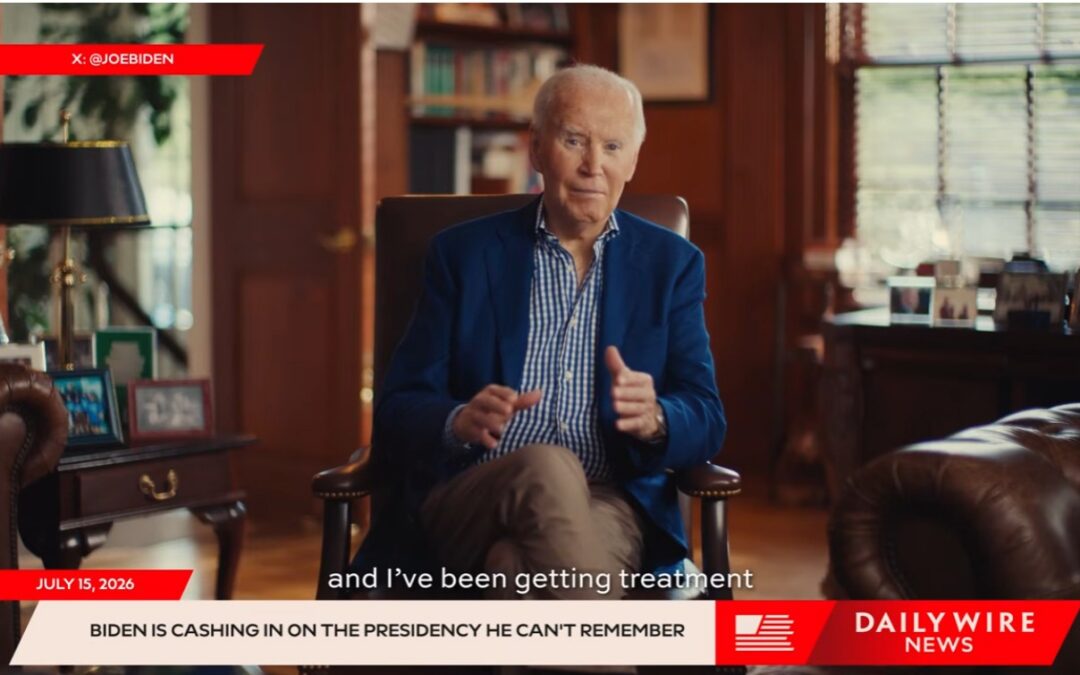
It wasn’t all that long ago that Americans talked about John McCain being the last of the “Silent Generation” to compete for the presidency. For history buffs, the recently-turned-80 years old Big Bubba Bill Clinton was the first Baby Boomer president, as was senile Joe Biden and current two-non-consecutive term commander-in-chief Donald Trump.
Presidents George H.W. Bush and Ronald Reagan were from The Greatest Generation. George W. Bush and Barack Obama were, like Biden and Trump, from the Boomer generation.
So, a good argument could be made that Trump and Biden were the last of their kind, though the criteria is strictly age-related and not necessarily tied to their numeric age. Trump seems much younger than his accumulated four-score years, whereas senile Joe Biden… well, you know.
In other words, any such “youth movement” in politics has a lot more to do with the actuarial tables than it does a clamoring among the citizenry to cast out the old and bring in the new. It’s just the way it is. President Trump has joked many times (and continues to do so) about serving as president well beyond his current term, but here’s thinking Trump would struggle mightily in today’s political environment to gain a voter-approved extension to his tenure in the White House.
As the last few elections demonstrated, it’s not so much that Americans care about a candidate’s practical age as they value leaders who don’t act old. There’s a difference.
As classic comedy character Lloyd Christmas (played by Jim Carrey) famously observed in Dumb and Dumber To, “Age is just a letter.”
Lloyd Christmas’s wisdom aside, age does matter in politics today, though not necessarily to suggest that older individuals can’t handle rigorous schedules or vigorous cognitive adversities. The natural aging process forces everyone to “slow down”, but there isn’t a discernible line to cross regarding the notion of how old is too old.
Likewise, as recent political developments have indicated, there isn’t an invisible floor for youth, even though the Constitution’s minimum age requirement to serve as president sets the line at Age 35. Here’s thinking a hopeful who’d try running for president at a more tender age would be laughed off the debate stage. If you don’t believe it, look at Alexandria Ocasio Cortez, who’s talked about wanting to be president for years but until the past couple cycles, wasn’t old enough.
It’s funny how commercial pilots and other professions fix a ceiling on how old a person can be to be licensed, but there’s no such numerical maximum for politicians, as though stresses and physical challenges included with bickering and back-biting over governmental issues aren’t a factor in politicians’ job performance.
The Founding Fathers probably didn’t ponder a durability limit since there weren’t that many statesmen who lived to an age where they were even capable of serving any longer back in the 18th century. Though John Adams did live to be 90 (but he left office at 65) and Benjamin Franklin was 84 when he passed, both were quite a bit older than Trump is now.
Regardless of the debate, as Datoc pointed out, 2028’s candidates are bound to be younger, which will provide a bit of a departure from the past twenty years or so. Most of the rumored White House aspirants are youthful enough to preclude any discussion of them being past their prime for the high-stress responsibilities of the president.
One would surmise Democrats would most certainly pursue a younger lead presidential standard-bearer, yet the current frontrunning contender is former nominee Kamala Harris, who will be 64 on Election Day, 2028, which means she’d be only a half-decade younger than Hillary Clinton was in 2016 (69). Will it make a difference to Democrat voters?
The newest vintage Democrat supporters (including the growing Democratic Socialists of America) didn’t seem reluctant to back elderly and crotchety Bernie Sanders during his presidential runs. The Bern was hospitalized for a mild heart attack during the 2020 campaign, and the health issue didn’t stop him from making a play in the first few voting states, throwing quite a scare into the Democrat bluebloods.
Here’s thinking cackling Kamala’s age wouldn’t be a disqualifier in 2028, despite the possible presence of several younger and more radical alternatives such as AOC and still-wet-behind-the-ears-looking Pete Buttigieg.
Republicans appear ready to make a generational switch in 2028, with Vice President JD Vance looking to inherit the MAGA mantle if he decides to run. Should the veep opt out, still youthful Secretary of State Marco Rubio is thought to be the next-in-line for the GOP mantle.
That being said, Donald Trump had no trouble deflecting age concerns in the 2024 campaign. The schedule and pace that Trump maintained was sufficient to answer the doubts of the people who mattered, Republican voters. Even now, Trump can be seen everywhere doing anything, and it’s a point of pride to handle a big share of the energy burden himself.
Democrats resurrect the age matter whenever Trump does something they don’t like. It’s less about the man’s physical and mental capability and more the fact they’re envious he remains effective at his age. Many of Trump’s Democrat critics are the same ones who insisted senile Joe was in charge and primed to serve a second term before they cashiered him and unceremoniously kicked him to the sidelines.
It seems evident both parties will weigh a candidate’s age and experience in the upcoming presidential selection process. The fact that almost all of the prospective contenders are younger than those of the recent past doesn’t necessarily signal a youth movement; it means Americans desire a fresh generational perspective on leadership.
Bring on 2028.
Jeff Rendall is editor and publisher of GolfintheUSA.com and has written about golf and politics for over a quarter of a century. A non-practicing attorney from California, he moved to the east coast three decades ago to pursue and combine his interests in all things American history and culture. Jeff has worked as an intern on Capitol Hill and in various capacities in grassroots organizing and conservative organizations and publications, including a nearly two-decade stint at ConservativeHQ.com. Column republishing or other inquiries: Rendall@msn.com