
By Jeffrey A. Rendall; Photos by Jeffrey A. Rendall
Our first visit to Sitka, Alaska included Eagles, Bears, Totem Poles, Salmon and lots of natural beauty
Sitka, Alaska. Sitka was the southernmost Alaskan port we visited in our cruise. After a bumpy first couple days of the voyage, we arrived in Sitka ready to discover the town’s ties to three cultures – American, Russian and Tlingit (Native American, prono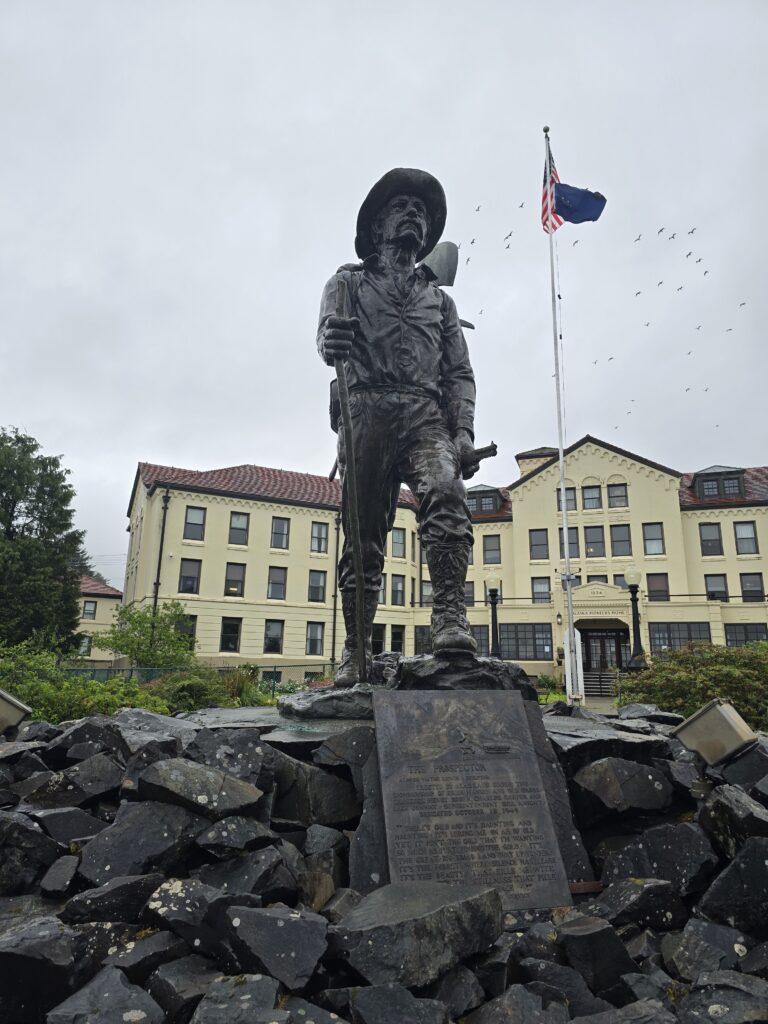 unced TLING-kit, KLING-kit).
The day was misty and cool as we disembarked. We were warned ahead of time that we’d need to take a shuttle bus to reach town. The shuttle tickets were free, but we reserved them just in case.
The bus dropped us at a Visitor’s Center where a couple hundred tourists had gathered and organized into various tours. The scene wasn’t exactly chaotic, but first impressions of Sitka were comprised of folks visiting a typical tourist destination and various vendors holding signs and soliciting clientele who didn’t have activities planned. Watching the vendors go after uncommitted tourists reminded me a little of fish in a fish hatchery leaping at pellets of food haphazardly tossed into a big pond.
We booked an excursion, but the meeting time wasn’t until the afternoon, so we immediately ventured into town in search of a store that sold warm clothing – not a parka, mind you, but something to keep us comfortable in fifties-ish degree weather. I purposely didn’t bring many warm clothes because I figured I’d buy some in Sitka, our first stop. Locating a store that catered to tourists wasn’t a problem. We found a “Christmas store” in Sitka and looked for ornaments that indicated the location they were from. My daughter bought a pocket knife for a friend back home.
That’s one thing you’ll note in an Alaskan town. There are lots of stores catering to tourists with shirts, hoodies, knives, mugs, etc. And jewelry. Lots of it. There are also a multitude of restaurants and bars/breweries to choose from. Locating a place to buy coffee isn’t difficult and the local population must work seven days a week during tourist season to accommodate the waves of knick-knack hungry souvenir hunters.
I bought a cool (in the keen sense) sweatshirt in Sitka. Something I’d been looking for.
After shopping, we strolled leisurely through the town, noting its history and connections to the aforementioned cultures. Sitka in particular had a place set aside for Alaska natives to perform dances and offered a number of “authentic” totem poles. Russian culture is all around, too, though the town’s ties to today’s Russia are few. President Trump was about to meet with Russian president Vladimir Putin – but the meeting would be in Anchorage, several hundred miles to the north.
We decided to get coffee (a blended Kona mocha) but opted to skip a heavy lunch, preferring instead to digest the cruise ship breakfast we’d partaken in before disembarking for the day. There was a shop that specialized in Russian pastries next door to the coffee outlet, but the sugar covered fried bread looked too filling for our taste. We enjoyed an unhurried hour or so soaking in the sights of Sitka and readying ourselves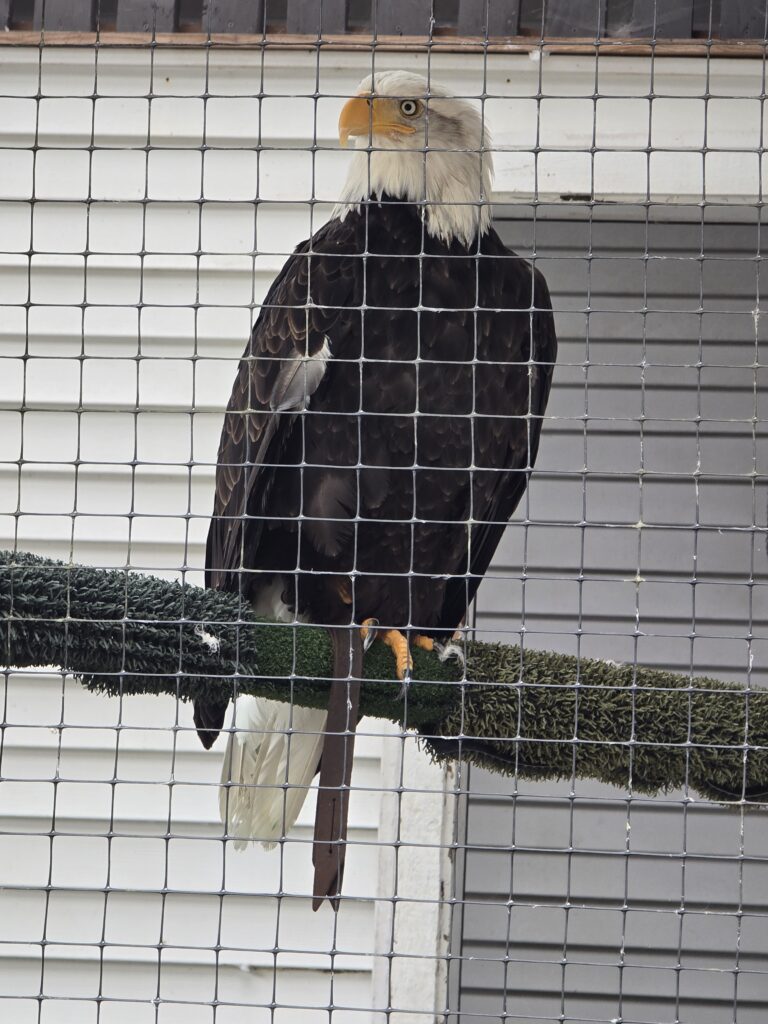 for a busier afternoon with raptors (eagles, etc.) and bears at the places built to showcase the regional wildlife.
At the appointed hour, we located our tour guide for the afternoon, a straight-talking woman named Katie who informed us we’d first be going to the Raptor center, the place where Alaska’s birds of prey are kept for rehabilitation (as necessary) and observation. This was where we could witness the birds up close, as it was unlikely for us to get such an opportunity in the wild.
The Raptor Center primarily had bald eagles but also contained hawks and owls. It wasn’t quite like a zoo – more like a humane and temporary place set up just for birds of prey to recuperate. Wild birds are taken to the center for various reasons, where they’re cared for and treated for injuries in hopes of eventually returning them to the wild. The center itself was quite crowded with beings of the human variety. It was noisy and fairly unorganized. There was a short video presentation with beautiful imagery on a big screen TV of raptor birds of various types. There was a large area for the rehabbing bald eagles. I think there were seven of the beautiful birds in the large “cage”.
Outside there were more holding pens for birds. There were three bald eagles that will apparently never return to the wild yet still will live out their days in relative “freedom”.
The Raptor Center was a good place to examine the birds of various types in close proximity, bald eagles in particular. For that reason alone, it was worthwhile to visit the Center, though afterwards we agreed that the 45-minute time limit we were held to wasn’t nearly sufficient and the narration of what we were seeing there wasn’t great. There weren’t many Raptor personnel explaining things about the birds or answering questions, though the people that were there were knowledgeable and helpful… and tolerated dumb questions… from others, of course.
There was necessary time for photos and video, but not much else.
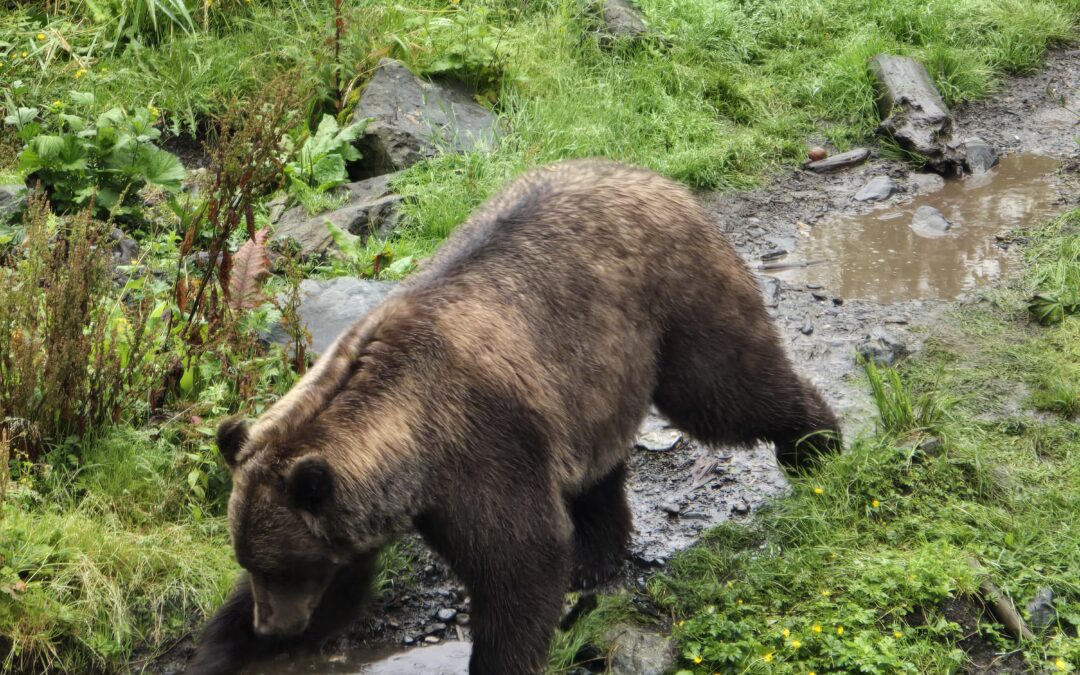
Then it was on to see the bears at the Fortress of the Bear exhibit, which was a few miles away from the Raptors, both well outside of Sitka. Fortress of the Bear was not quite like a zoo, but the bears themselves are contained in large “pens” with a landscaped “wild” habitat designed to hold the distinctive furry creatures. There were several brown bears (in two exhibits) and three black bears at Fortress of the Bear (which did, from the outside, indeed look like a Fortress).
The two types of bears can’t be kept together, apparently. I guess it’s because they’d fight.
All the “pens” offer decent viewing of the bears themselves for their human guests, the animals basically existing in their environments surrounded by a healthy representation of gawking tourists. Where else could you  get a chance to see the large animals almost within conversation distance? The bears themselves didn’t look intimidating, but we were repeatedly warned to not drop anything into the pens themselves – or risk not ever getting the items back.
Were these grizzly bears? No. They say grizzly bears are brown bears, but not all brown bears are grizzlies. According to the narrators, grizzlies aren’t found in this part of Alaska. Why this is so, it wasn’t clear. In fact, the region around Sitka doesn’t have black bears either, but they had a chance to house a trio of black bears from a neighboring island, and took in the dark colored creatures.
We had 45 minutes to spend at Fortress of the Bear and devoted the majority of our time to scrutinizing how the bears interacted with each other. There was one large male brown bear who seemed to ham for the audience by standing on his hind legs and doing something more than just staring back at us, though again, we were advised not to call out to the bears or disturb them in an overt way.
The brown bears appeared to dance and act up for the visitors. Cute? Maybe at this type of enclosure it was funny and entertaining. But I wouldn’t want them to come through my campsite regardless.
We also got to witness feeding time, with staff tossing the bears partially cleaned fish to eat. The Black Bear area smelled horribly – just like the wild, I’d guess. According to the guides, the brown bears eat the fish right away. The black bears, on the other hand, “play” with their food before eventually devouring it, which accounts for the odor. Yuck.
Additionally, there was information about each one of the bears near the pens and why they were there. None of the bears at the Fortress will ever return to the wild. The furry inhabitants are too conditioned to humans now. In fact, the locals are forced to kill bears that become too accustomed to humans. That’s when they become dangerous. Bears will look for food wherever they can. To save the bears, leave them alone.
Unlike with the Raptor Center, 45 minutes seemed like adequate time at Fortress of the Bear. It was enough opportunity to learn about the bears in their present circumstances, buy some hit-the-spot popcorn from a local food truck near the entrance and then head to the last destination, Sitka National Historical Park, a local park where visitors could take a walk in the woods, see a wild, rushing stream full of spawning salmon and behold an assortment of totem poles.
Katie walked with us on the 20 minute trail tour of the park. She was knowledgeable and friendly and relayed facts and anecdotal stories about the native culture (Tlingit and Haida) that created the poles. The time there was “free” to use either on the trail as we did, or take in the visitor’s center. We couldn’t have done both.
As previously mentioned, there was a river about halfway through the park trail. Salmon were swimming upstream to spawn and die. The fish were huge, but near the end of their lives at this point, aren’t good eating. Bears and Eagles don’t mind the noxious flavor. Nothing gets wasted in Alaska.
The totem poles were interesting. They symbolize certain things, though to the untrained observer, they don’t make much sense. It’s impressive that each one is hand carved and many of them painted, though the paint doesn’t last long in the cool and damp environment.
Each of us agreed the national park stop was a pleasant surprise and well worth the time there, though again, it wasn’t long enough to immerse ourselves in the subject matter. After most of the day in Sitka going through shops and exhibits, it all seemed like a short stay. It was enough, all in all.
Katie also helped shatter one entertainment industry myth about Sitka, Alaska. The Sandra Bullock movie, “The Proposal”, which was portrayed as taking place in Sitka, was not actually filmed there – or in Alaska at all. Say what?
Hollywood pulls location setting tricks all the time, but how did they make this deception work? Katie said the film was actually filmed in Maine. It turns out she was wrong, too. From Wikipedia: “The film The Proposal was not filmed in Maine. Principal photography took place primarily in Massachusetts, specifically in Rockport and Manchester-by-the-Sea, which stood in for the fictional Alaskan town of Sitka.
“Scenes were filmed at locations such as Bearskin Neck in Rockport, including the Motif #1 building, which was transformed to appear as ‘Sitka, Alaska’.
“The house used for the Paxton family home was actually located on Gales Point Road in Manchester-by-the-Sea, Massachusetts.
“While the film’s plot is set in Alaska, no scenes were filmed in the state, and there is no evidence of filming occurring in Maine.”
So much for promoting Alaska. What a farce. I can’t look at “The Proposal” the same way again.
At the conclusion of the tours, Katie did us a favor by driving us back to the ship instead of being forced to catch the shuttle “home” from the Visitor’s Center. It turns out the addition of a deep- water port brought the cruise ships to Sitka, which increased the business by many, many times for the people who live there. One gentleman put up the money to build the docks. Tourism is now a major industry in Sitka, second only to fishing.
We enjoyed our hours in Sitka as well as seeing the raptors, bears and local park with the totem poles. As was usually the case, we could’ve used additional opportunities to learn about the birds and the bears. But cruise excursions aren’t usually good places to soak up regional knowledge and immerse yourself in culture. Bring your cameras, jockey for position and get your fill of imagery. Then stockpile the memories.