
By Jeffrey A. Rendall, Photos by Jeff Rendall, Matthew Rendall and Hallie Foulke
Hidden gem Wild Florida Adventure Park – where the African Savannah meets the Florida Everglades
 “I wanna see alligators.”
The simple request from a member of our traveling party seemed easy enough to grant. As everyone knows, alligators are everywhere in Florida, and in some places, you see them whether you want to or not. Find a body of water in the Sunshine State and chances are, sooner or later, you’ll come across a toothy reptile.
But finding gators in places that are acceptable – and safe – is a different matter. Rumors of dangerous encounters are many, though it should be noted that, in general, alligators don’t want anything to do with humans. Just keep proper distance from the big ones, and by all means, don’t allow small kids or pets to test them. They’re deceptively fast and aggressive when they want to be.
Disney has their Animal Kingdom park which, if memory serves, includes a tram-type ride through a “wild” section where all sorts of free-range creatures are found. I grew up in southern California, which used to have Lion Country Safari, where you could even take your car through it. It’s been about a half century since I’ve been there, but I seem to recall the park closed due to people venturing too close to the beasts and not respecting their space.
A token few people ruin it for everyone, don’t they?
But upon doing some research and continuing our quest to find non-Disney activities that wouldn’t break our budget, we found a place called “Wild Florida Adventure Park” which purportedly offers a wealth of wild animals on open acreage – and sure enough, you can experience it from the comfort and safety of your own vehicle.
For additional dollars, you can book an airboat ride through the Everglades at Wild Florida, which I’d imagine would be worth the additional expense. But we didn’t want to commit the extra coin – and we thought the drive-through park would provide enough animal sightings to last us for a while.
What about gators? Well, according to the park’s website, there’s a Gator Park that’s included with your admission. This place sounded exactly like what we hoped to see, so we headed in that direction.
Wild Florida’s website describes it: “In 2010, Wild Florida Adventure Park set out to preserve one of the few pieces of private property on Lake Cypress in the Headwaters of the Florida Everglades. With an eye on polishing one of the jewels that is a throwback to what Florida used to be like, Wild Florida Adventure Park gives Orlando visitors and local residents a glimpse of what it’s like to explore the wild side of Florida.”
Ain’t that the truth. It was a little over an hour’s drive from our resort to the park. The last ten or so minutes takes you out into the countryside, with mostly cattle grazing and humans sparsely present in their own environments. We’d almost thought we were lost a time or two with the trusty GPS indicating the entrance was some miles further.
 We passed the entrance to the Safari before reaching the main visitor’s center where you purchase tickets. The staff sold us our passes and recommended we take in a couple of the shows at the Gator Park prior to going on safari, which they said takes about an hour and a half – and you can travel through as slow or as many times as you’re inclined to do when you cross through the gate to the other world.
What could be better? An amusement park for $35 per adult and you can go at your own pace. Including tax, it was less than $120. We did buy a couple pictures with us holding “Fluffy” the baby alligator, which was about $20 additional. What price do you place on memories?
Luckily, a couple of the shows were about to start, so we wouldn’t have to wait long. According to the brochure, “You’ll find lemurs, bobcats, two-toed sloths, and other wild animals. Of course, you’ll find plenty of alligators in their wild habitats.”
We noticed the big reptiles almost right away. The gator feeding started almost immediately upon entering the Gator Park and a couple staff narrated the “show”, which consisted of dangling pieces of chicken on a rope above the swimming gators. Sheesh. About eight or ten of them recognized the chance to take a free snack and meandered towards the food.
Sure enough, the gators began leaping above the water to snatch the waiting morsel. The audience oohed and aahed in wonderment as the monsters “performed” doing little more than taking what was offered to them. The narrator guide recommended cheering on the gators as the chicken was presented to them. Supposedly, it encourages them to “perform”.
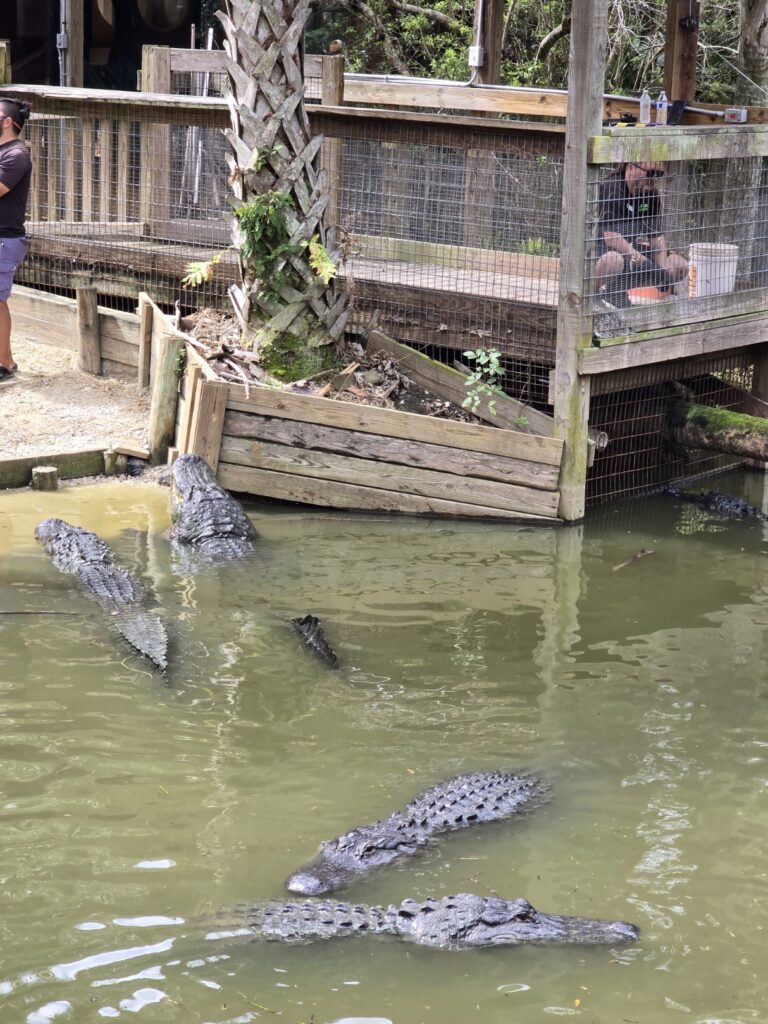
The gators swam close to us but far enough to not be apprehensive about it. The audience members don’t end up getting that close. The narrator offered an additional gator treat to a couple large ones that had swum towards him. Wow, it was something to behold. Apparently, there are 60 or so gators in the large pond, many of which were visible on the shoreline sunning 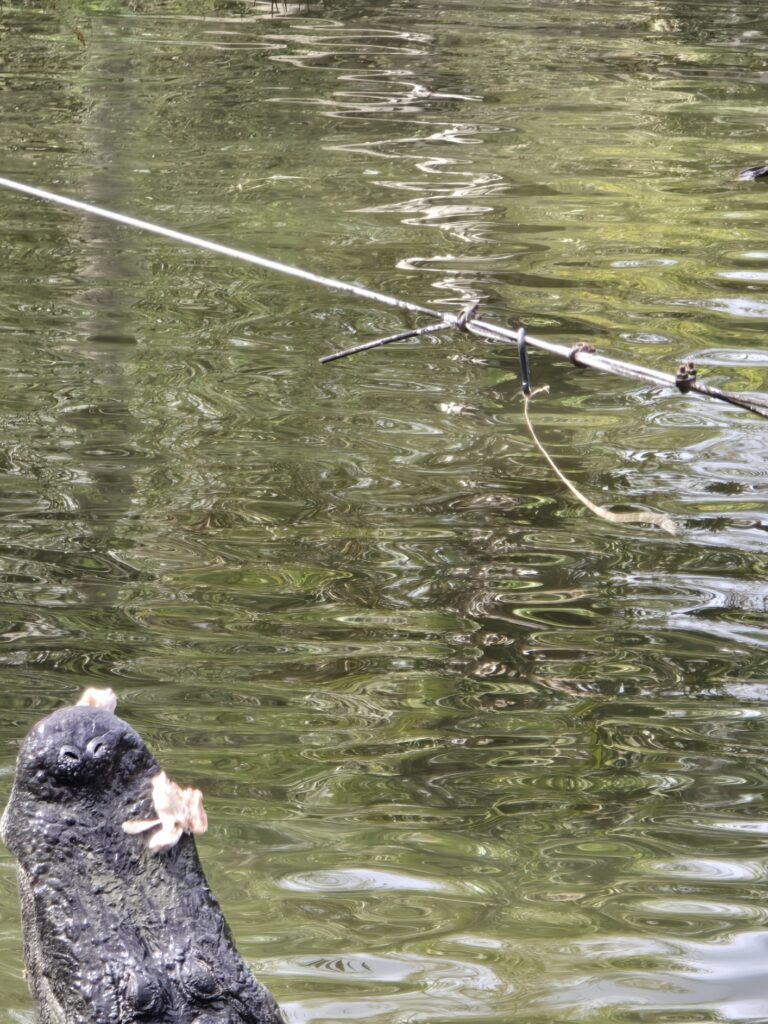 themselves and not doing much at all.
Talking to the very approachable narrator afterwards, he noted a couple things about gator behavior. All of the alligators at the Park were taken there because they became “nuisance” alligators who associated humans with food. You know, people feeding the gators, which is against the law in Florida. Alligators aren’t dangerous except when humans make them so.
Also, I asked what would happen if somebody fell – or jumped – into the pond. “The animals would react like whatever was there was probably food,” he said casually. And there’s no protocol for rescuing someone from the gators. So… I guess you’re on your own if you want to tempt fate.
According to the gentleman, many professional animal trainers try to get jobs there. One of them, “on duty” that day, was from Arkansas and led the feeding effort. It’s a special place.
One other note about alligators. Since they’re cold blooded, they need special considerations if cold weather is expected, which doesn’t happen often in central Florida. But a couple weeks prior to our visit the region experienced quite a cold snap. The staff had to take the gators inside or make accommodations to keep them alive. What about the millions of gators out in the wild?
One can only wonder. Lots of alligators succumbed to the cold. But not at Wild Florida.
Near the gator pond was another small theater-type area where the “Exotic Animal Encounter” was about to begin. The gentleman who set up the gator feeding show brought out three exotic animals, all of which provided a chance to get up close and personal with the wild creatures. Have you ever wanted to pet a wild snake? There’s your opportunity! The scaly reptile was paraded by the handler around the stage, thrilling kids and making some of the adults skittish.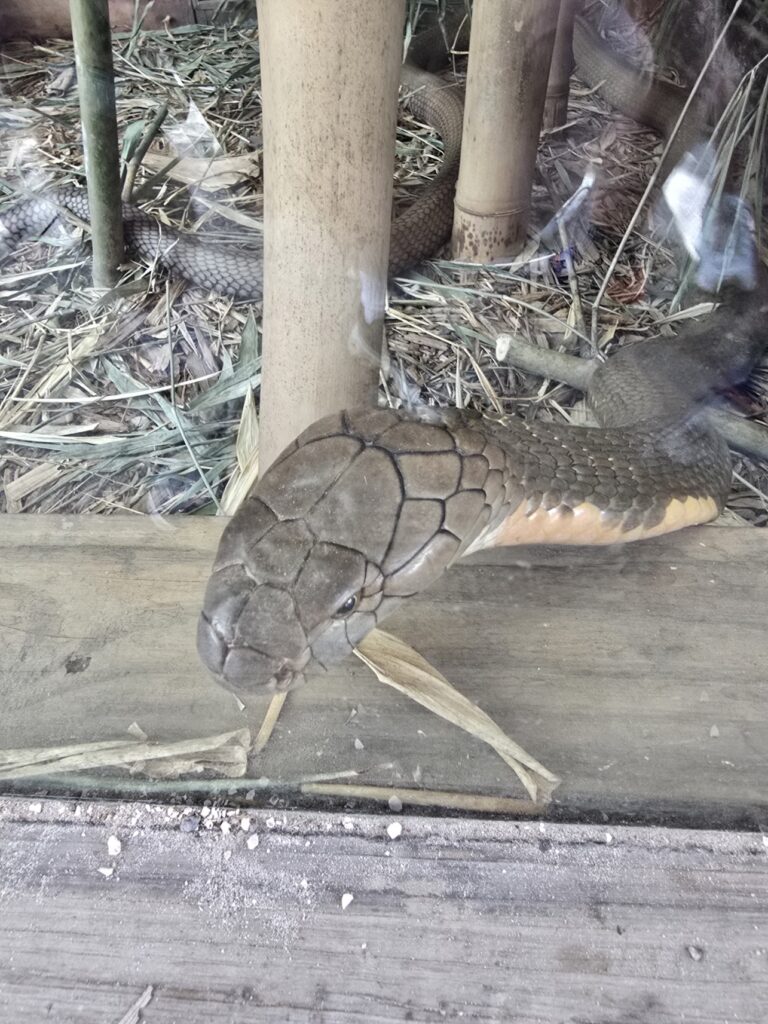
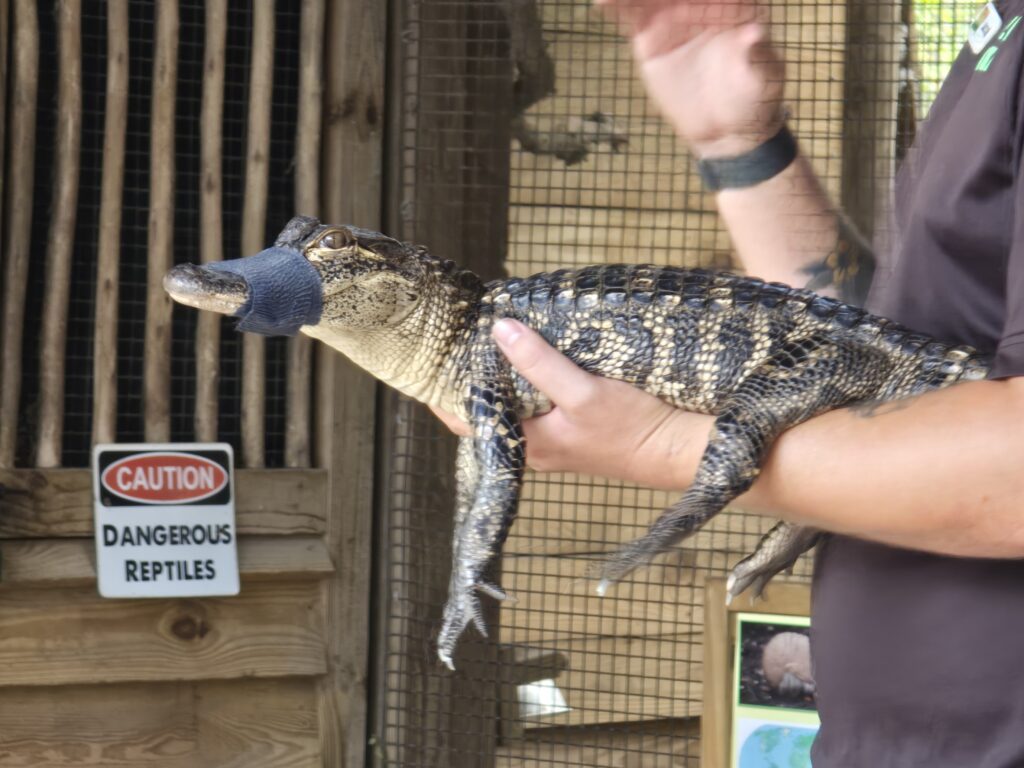
The last creature was a small alligator named “Fluffy”. Ironic name, huh? Pretty cool. We were told we could get a picture holding the gator if we wanted after the show. For purchase, of course. But they need to make money to keep the place running, right? Wild Florida is not like Disney where so much of it is animated and a bit contrived.
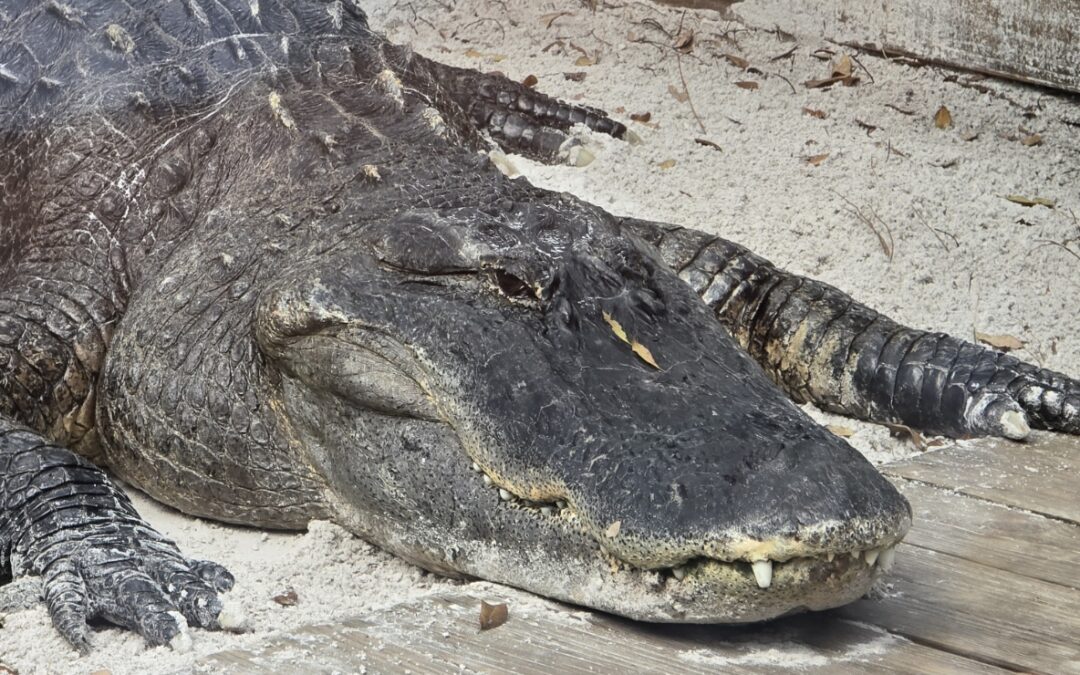
Note: We did stop in to see “Crusher” the 13+ foot alligator, but he was simply lying still and soaking in the sun rays. It was like Crusher was taking a day off.
The last part of our visit to the Gator Park included checking out the venomous snakes, displayed in cases with explanations of where each one is from and what they’re known for. Lots of dangerous snakes in the world, for sure. There also were other odd animals, such as Lemurs, from which I said, “Hey, Zoboomofoo!” – the old PBS Kids show that was one of my youngins’ favorites. Sadly, my son didn’t remember it at all. Such is life.
 With the gator world safely explored, it was time for the main event, a slow cruise through the Safari park. The area was obscured by a fence high enough to hide the animal occupants. Was it there to keep the poaching visitors out, or to keep the wild ones in?
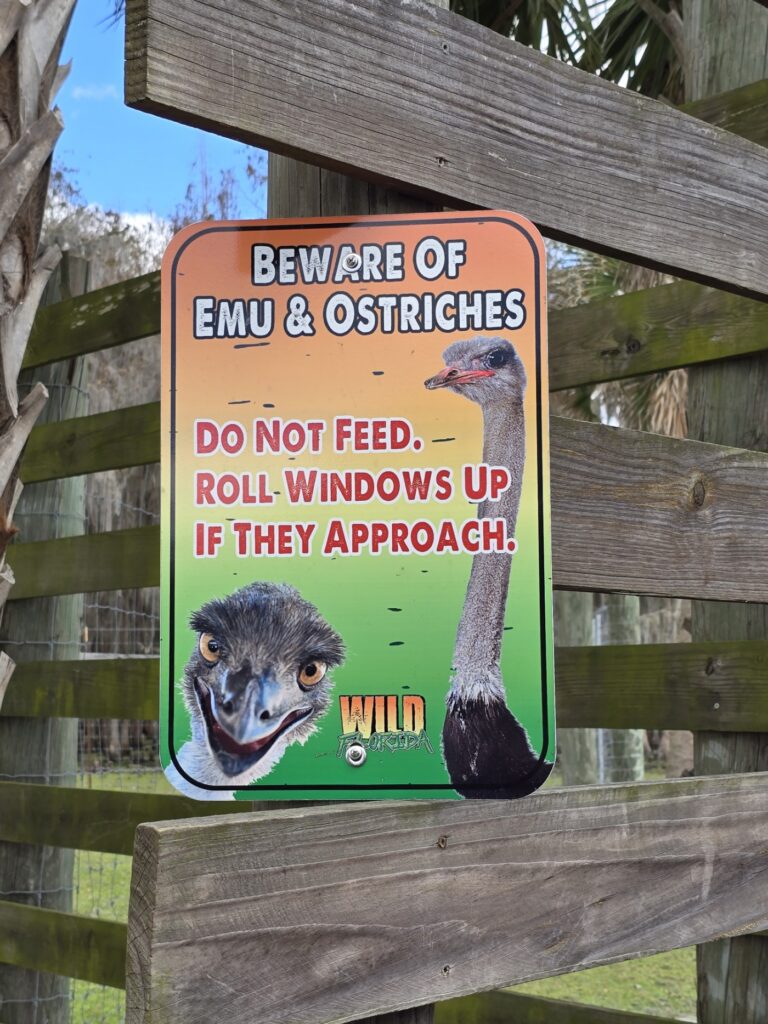
The attendant in the booth reinforced a few of the simple rules before entering. Keep speed down and windows rolled up if/when animals approached. Common sense, really. Ostriches especially were known to get up close and personal to people with their car windows rolled down. And Emus too. The Australian birds were mysterious. No wonder “Limu Emu” had his own advertising campaign, though Doug was nowhere to be found at Wild Florida.
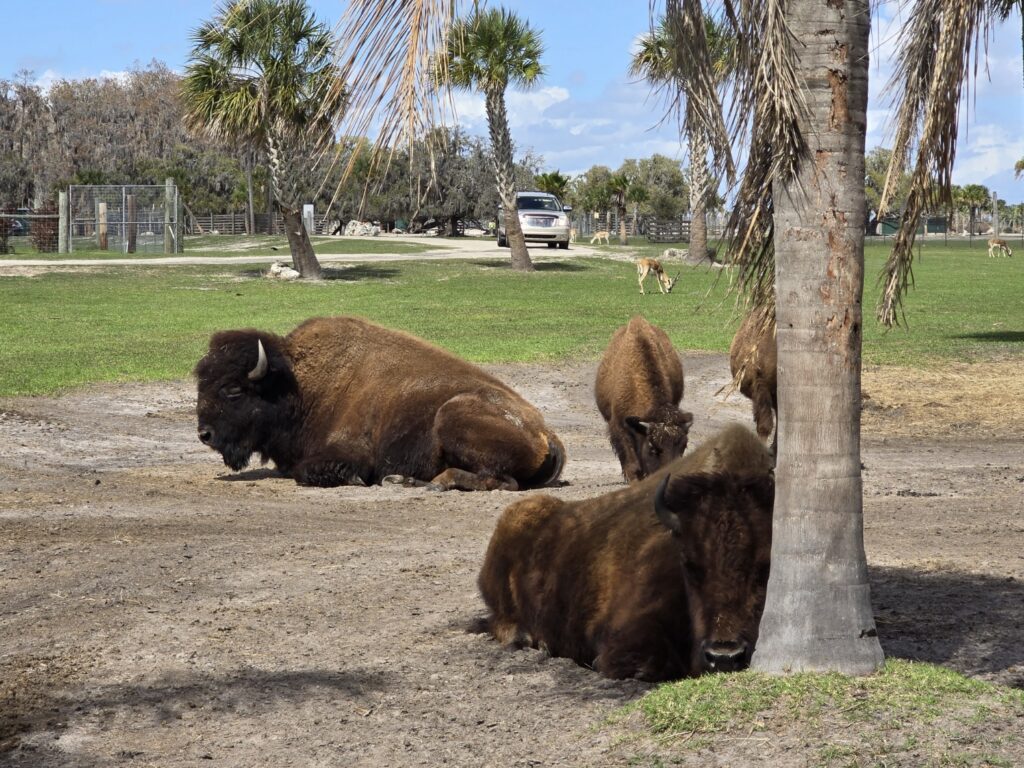
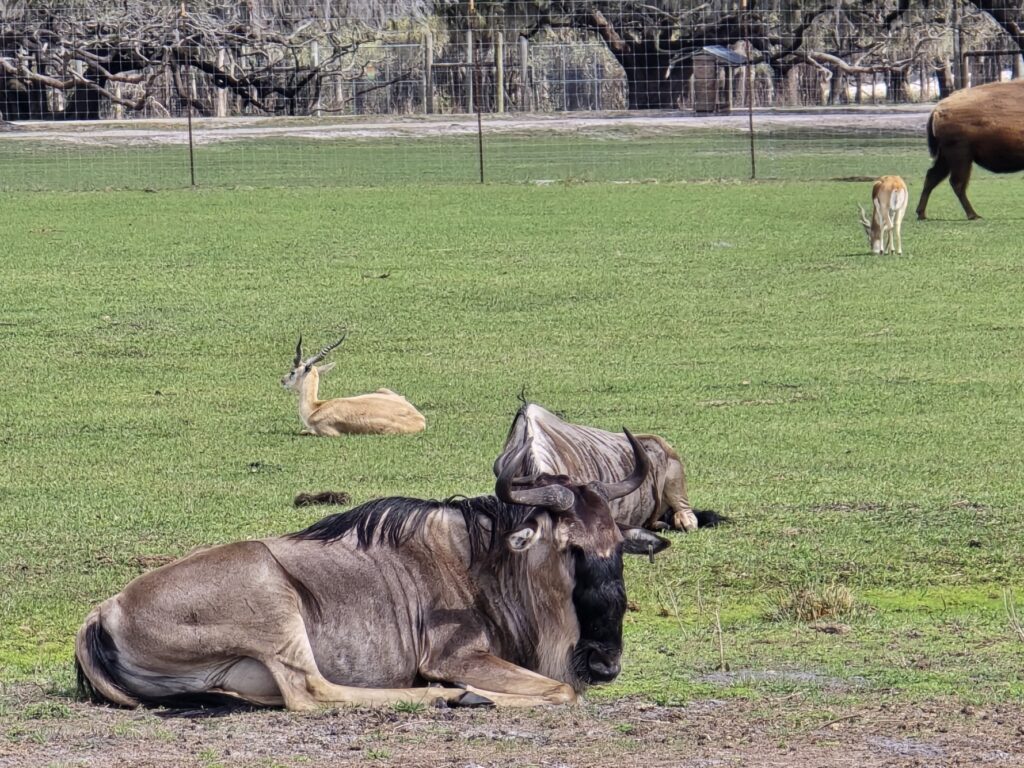
We observed, more or less, the 5 mph speed limit and tried to read the brochure as we went along, reciting a blurb about the animals we saw in their environments. It was a warm, almost summer-like day, and many of the animals were favoring the shaded areas. In no particular order, there were Reticulated Giraffes (actually, the last animal we saw), Bactrian Camels (two humps), Dromedary Camels (one hump), Nilgai, Gemsbok and Bongo (horned antelope-type animals), Bison, Elk, Scimitar Horned Ortx Axis Deer, Alligators, Ostriches, Crocodiles Ringtailed Lemurs, Fallow Deer, Emus, Waterbucks, Zedonk & Zorse, Zebras, Kunekune Pigs, Brahman Cattle, Wildebeest, White-tailed Deer, Water Buffalos, Sika Deer, African Geese, Highland Cows, Banteng Cattle and Pere David’s Deer… among others?
Spelling and pronunciation test comes later!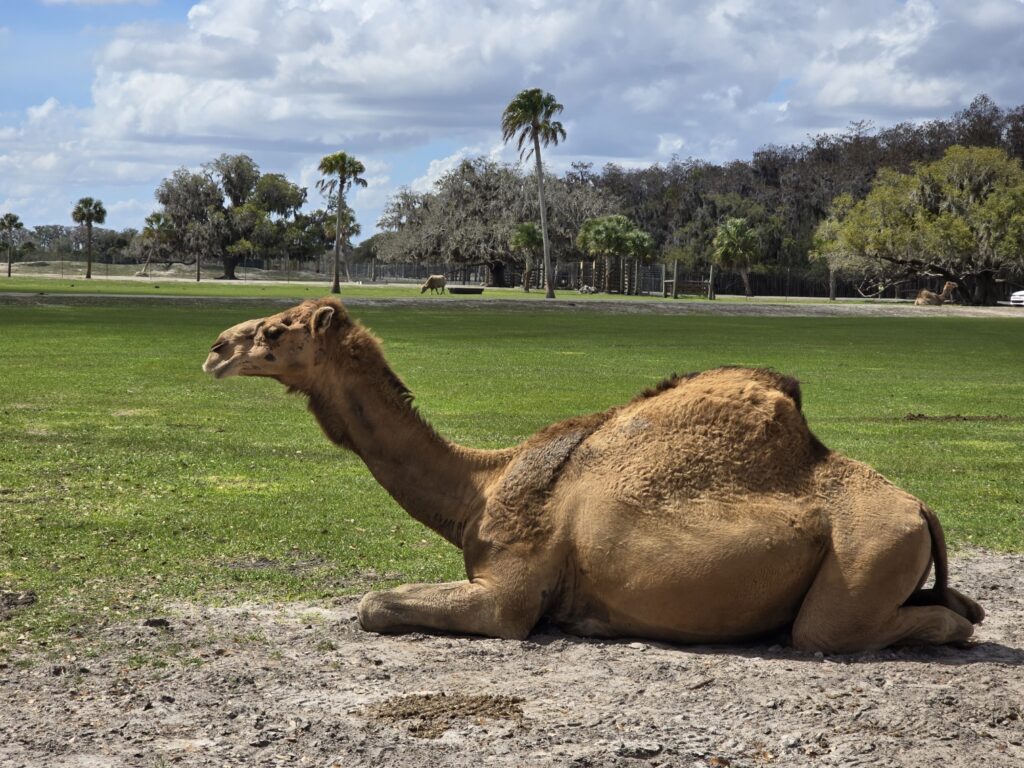
The journey through the Safari park did take about an hour and a half with frequent stops to read about the animals we were facing. Many/most of them we’d seen at some point in zoos or other wild-animal parks, but not up this close and the entirety of the animal world seeming to live in proximity and coexist in peace. The more dangerous animals were cordoned off by fences. The crocodiles had their own pond about an acre or so in size. Humongous and scary. It was quite a treat to be able to see them with the knowledge someone else had to care for them… and feed them.
There weren’t any lions or hyenas or tigers or bears or other dangerous fauna that could be threatening at Wild Florida. I’m not sure why, but there were plenty of animals to see, nonetheless. No rhinos or hippos or elephants, either. But aren’t they endangered?
 I would say the Nile crocodiles were the most interesting creatures to try and understand, if for nothing else, their sheer size and fright factor. They differ from the Florida crocodiles, though it wouldn’t be advisable to mess with either type.
I wish I had asked the Wild Florida staff about the state’s invasive python problem. I’ve read that they’re all over the Everglades and there are special hunts to try and hold down the population so as to preserve native species. One of the most noteworthy facts of life in today’s Everglades, truly one of the most mysterious and prolific of environments in the United States.
It was an unforgettable experience, one we hope to revisit someday. A three-hour visit to Wild Florida was plenty and not enough at the same time. The Park offers airboat tours of the Everglades in addition. They sound very, very interesting. Like everything else, saved for a future return.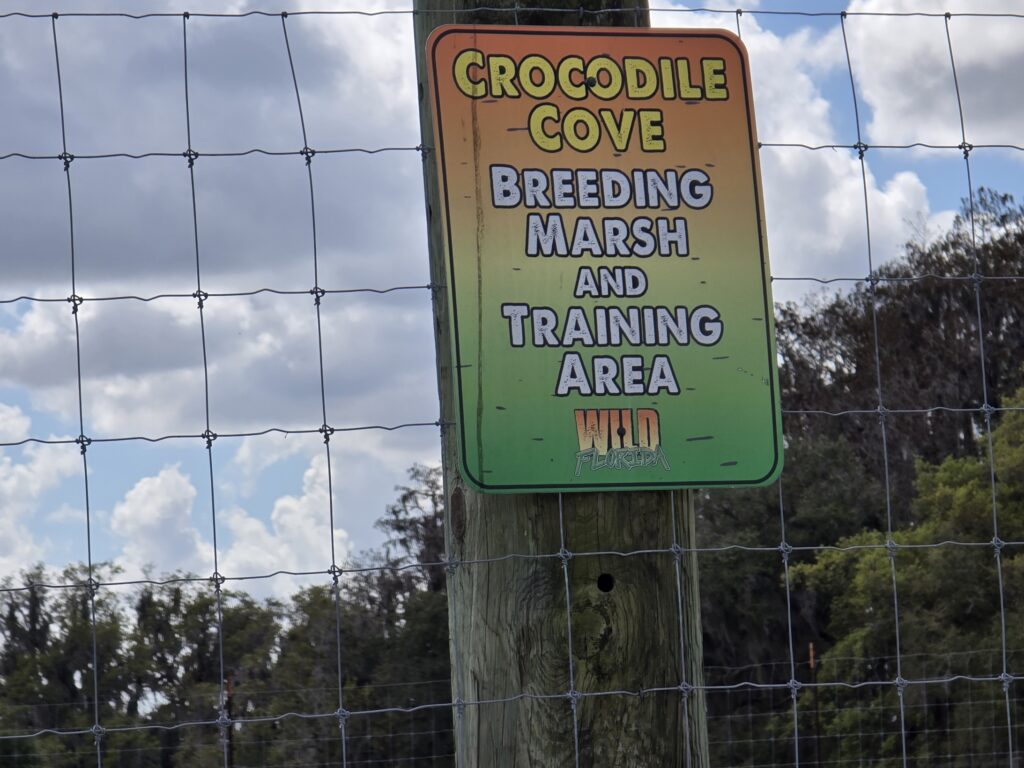
If you’re searching for a non-Disney activity that is accessible and not as crowded, the Wild Florida Adventure Park might be your ticket.
Wild Florida Adventure Park
Website: https://www.wildfloridairboats.com/
Next: The ocean meets Orlando theme parks at Sea World (Orlando)
Florida Spring Part I – Family friendly major league baseball spring training and why we decided to avoid Disney: https://www.golfintheusa.com/2041-2/
Non-Disney Florida Excursion: Day Two brought more baseball in Lakeland Florida, visiting the Detroit Tigers’ facility: https://www.golfintheusa.com/non-disney-florida-excursion-day-two-brought-more-baseball-in-lakeland-florida-visiting-the-detroit-tigers-facility/
Non-Disney Florida Excursion, Day Three — Touch an iceberg and live at the Titanic Artifact Exhibition: https://www.golfintheusa.com/non-disney-florida-excursion-day-three-touch-an-iceberg-and-live-at-the-titanic-artifact-exhibition/