

Note: GolfintheUSA.com first ventured to Bandon Dunes in the summer of 2005. We revisited the Pacific Dunes Course again in 2025. The course is largely the same since its creation and launch. The change in impressions are ours.
BANDON, OR – Many have portrayed golf in the most personal of terms, and many others have described its greatest golf courses using religious terminology – at times, borrowing words like ‘shrine’ and employing concepts such as ‘pilgrimage’ in an attempt to impart special meaning on a particular patch of ground, or stretch of holes.
Just for example… ‘Amen Corner,’ anyone?
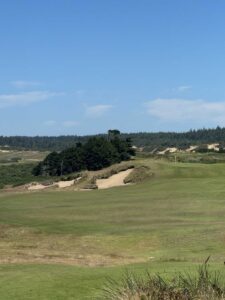 Whether or not this practice constitutes sacrilege is up for debate, but those same folks who speak of the game’s greatest places as being ‘holy’ are again exercising their expressions to describe Pacific Dunes, the Tom Doak inspired masterpiece along the shores of the Pacific Ocean in central Oregon. Opening in 2001, Pacific Dunes came two years after the original course at Bandon Dunes Golf Resort (named ‘Bandon Dunes’), but many have called it their favorite course at the destination, if not the entire country.
Jeff Simonds, Bandon Dunes’ Director of Golf, says it’s just that – a quasi ‘religious’ experience for avid golfers who experience Pacific Dunes for the first time: “Most people are literally stunned when they see Pacific Dunes, because it’s such a unique place. It almost redefines what is possible in the world of golf – it’s that awe-inspiring. Its peerless beauty is the most obvious thing, but when you really buy into it and have played it three, four, five times, you’ll discover the strategic elements that make it the complete golf experience. Pacific Dunes just keeps getting better, if that’s even possible.”
Simonds’s got some familiarity when it comes to ‘religious’ analogies on golf courses, having spent time working at the consensus number one-ranked resort course in the United States, Pebble Beach – which has engendered a healthy amount of praise and devotion onto itself. He won’t comment on whether Pacific Dunes surpasses its California coastal relative, but he will say the overall experience at Bandon Dunes Resort is superior.
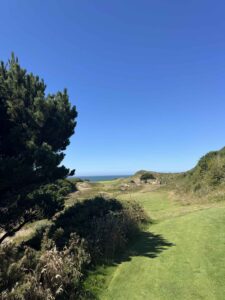
Pacific Dunes is part of that superiority, being about as natural as could possibly be expected of a golf course. Simonds says very little earth was moved in building it – the ground was literally sand-capped and shaped, and they started growing grass. The result was a site with hugely exposed sand dunes that double as bunkers, where players get nothing but the feeling of playing golf in the middle of someplace, not knowing precisely where that might be.
 Doak’s equally proud of it, but insists Pacific Dunes is really the story of a harmonic convergence of golf’s essential elements. “From the day we started until the day we finished, everyone, from the owner, to the project manager, to the superintendent, to the construction crew – was on the same page. We all looked at creating Pacific Dunes as the chance of a lifetime and that positive attitude is evident in the results.”
“Someone wrote that designing Pacific Dunes was ‘the project [I] was born to do,’” Doak continued. “That was a nice way to put it, because working at Bandon really felt like that from day one. A lot of great courses have been changed and evolved into their present form – I’m sure Pacific Dunes will evolve too – but not many courses have looked as good as that one did on the day it opened, and we take pride that we really haven’t had to change a thing since.”
Indeed, Pacific Dunes sits adjacent to its slightly older cousin, Bandon Dunes, and offers a similar ‘style’ of play, but admittedly its aesthetic appearance is completely different from the first course. Doak and David McLay Kidd (Bandon Dunes’ architect) did quite a job of creating an atmosphere of pure ‘old country’-type links golf, complete with mandatory walking, no real estate and the absence of on-course artificial distractions that you’re bombarded with in most other places.
But when asked if he was intentionally trying to replicate a Scottish/Irish links experience, Doak was somewhat hesitant: “I hate to describe anything as ‘true links’ because the words have been wrongly used so often, but I think the courses at Bandon play more like links courses than anything else in America. The fairways are tight and firm and the balls roll forever, and you have to allow for the wind and the bounce of the ball when playing your approach shots.”
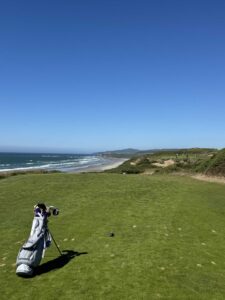 We’re not going out on a limb when claiming Bandon Dunes’ courses are unique in the ‘new world,’ yet it was a somewhat odd collection of talent that came together to create it. Owner Mike Keiser first sought out a perfect piece of land to create a true links experience in America, and he found it in central Oregon – a stunningly beautiful but climactically desolate (and access challenged) region of Pacific coastline prone to ferocious winds and cool temperatures.
Having traveled through the region a few times, there’s no wondering why the Beach Boys never sang of Oregon as a beachgoer’s paradise – the water’s freezing and the wind blows so hard you’re literally scourged by sand burn.
But it’s nearly perfect for links golf, closely identified with natural elements of wind, sand and semi-barren land. It’s a trick of fate, perhaps, that the game of golf was invented with these types of conditions in prevalence, but if you want to play golf ‘the way it was meant to be,’ this is about as close as you’ll come in North America.
Doak tells how he got involved: “A couple of mutual friends told me that Mike had acquired this piece of land, and I called him to ask if I could go have a look at it (this was 1995). David McLay Kidd was already in line to design the first course, so I became first in line to do a second course at that time, and got to know Mike Keiser fairly well between then and the spring of 1999, when we started work on the design.”
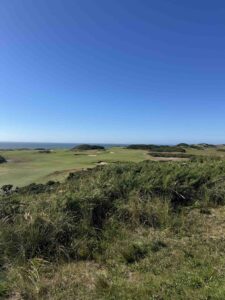 Doak said from just visiting the property he grasped its potential – so much so, that he might never see anything like it again for the rest of his life. It had tremendous variety in terrain and vegetation, and the views off the hundred-foot cliffs down to the Pacific were spectacular – and even the in-land scenery was inspiring. He called it as good a ‘canvas’ as any golf architect could ever dream of.
The fact that gorse covered the land also was a positive factor – not only would it give the courses a real ‘authentic’ links feel, it also helped alleviate any environmental concerns (with wetlands), and streamlined the permitting process. But clearing the prickly, prolifically growing shrub was another matter, one of the hardest parts of constructing Pacific Dunes, according to the people who were there. Doak said a wildfire helped out by burning much of it away a few months prior to beginning construction.
Not only was the land nearly perfect for what Doak had in mind, but the mental harmony extended to Keiser’s and his thinking as far as what kind of golf course it should be. “Mike Keiser talked in terms of the ‘retail golfer,’” Doak explained, “and we were keenly aware from the beginning that this was a resort course first and foremost. Certainly, I wanted to build something that would be seen as a ‘great course’ by those interested in architecture, but that was secondary to Mike.”
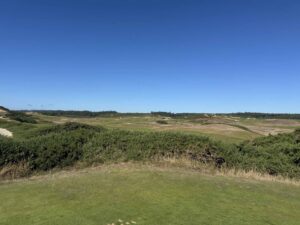 “There was some discussion about whether the golf course was long enough (at just over 6,600 yards, according to the yardage book) to challenge top-level players, but I reminded Mike that they weren’t the main audience for the course, and that if he wanted to host a championship, the Bandon Dunes course was long enough for that already,” Doak added.
“In the end, making the course shorter has made it more enjoyable for all levels of players. Club pros can actually go out and have a chance at a good score on calm mornings, but I’ve never had anyone tell me that Pacific Dunes was too easy,” Doak said proudly.
The key word in Doak’s last sentence was calm. 6,600 yards doesn’t seem like much, even to long-hitting average players, but when you’re contending with a stiff ocean breeze, those yards will make you earn your way around, inch by inch. Pacific Dunes runs pretty much north and south (as do the prevailing winds, in either direction), so you’re contending with one direction that will play short, and the other will seem as long as any you’ve ever wrestled with.
 Not to mention the links conditioning of the course (which you’ll find on all of Bandon Dunes’ layouts). Doak mentioned above that Pacific Dunes plays like a true links course, and that’s due to the exhaustive efforts of the resort’s maintenance staff and superintendents (each course has its own leading man; Pacific Dunes’ is Andrew Perrett).
For those who measure optimal playing conditions by deep shades of green, you’ve got some surprises in store – true links land is firm and fast (and that means slightly brown, in many aspects), and that’s the way they play it at Bandon Dunes.
Simonds says it comes as a shock to some, but requires adjustment for all: “Our ability to provide links playing conditions begins with the sandy soil and fescues we have, which makes for hard, firm, fast conditions. And we keep it that way. We could over-water and over-fertilize to green it up, but that would take away from the way these golf courses were designed to play.”
He continues, “To be honest with you, once we get the grass to a situation where the roots are really nice and strong – and it’s green and healthy – we then ‘stress the grass out.’ We want it slightly brown. We don’t want to have rich, lush green grass fairways with mowing stripes, because that’s not links golf.”
 Because of the philosophy and implementation of the plan, the courses hardly ever play soft or wet. One of the starters mentioned that he’d never seen a puddle on any of the courses – because they drain so well, even after a rain. Not only does Pacific Dunes and the others at Bandon look the part, they play like links, too.
That involves moving the ball along the ground, and often times, playing away from the flag. Simonds says that’s especially crucial at Pacific Dunes. “It’s definitely a shot-makers course, because there’s a fine line between hitting a great shot and hitting a bad one. Pacific Dunes is tighter than the other courses, and you’re just trying to play the ball into the best areas, regardless of the wind direction.”
A good example is the fourth hole, a long par four along the cliffs that have made Bandon famous. At 463 yards, you’re tempted to save a little distance by playing as close to the cliff as you dare, but even if you hit the fairway, the ball might roll into the hazard (because it gently slopes right, towards the water). There’s a bunker on the left in the landing area, and Simonds says you should actually try to hit it in there, because the slope will steer the first hop towards where you want to be. Then, going towards the green, aim left of the putting surface and let the contours of the green complex take your ball towards the target. If you’re shooting for the flag on that green, even what appears to be a great shot will probably roll off the putting surface.
Simonds expands on the notion: “From a player’s standpoint, if you choose to be aggressive on certain shots, the layout will punish you. But if you simply play Pacific Dunes with bogey in mind, and play to certain areas and get away from target sensitivity – away from the flag – it’s a very playable golf course. The harder you try to fight it, the more it will resist.”
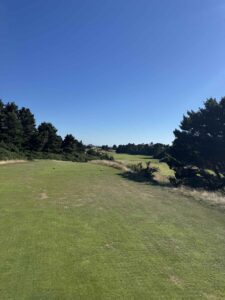 “But if you buy into how to play it, and when you get to the first tee, realize that you’re going to be in for something a little bit different – and that maybe your worst enemy on the golf course is yourself… the more fun you’ll have,” Simonds explained.
Thankfully, fun’s not an issue at Pacific Dunes. With that kind of beauty and creativity, it brings the sharpest awareness of what golf is ‘meant to be.’ Put another way, it’s golf’s ultimate consciousness encounter, for those pilgrims seeking enlightenment in flagsticks and tee markers.
GolfintheUSA.com’s Matthew Rendall’s impressions from his own encounter with Pacific Dunes in August, 2025:
I’ve played golf in windy conditions before, but teeing it up at Pacific Dunes, situated on Oregon’s coastline, truly demonstrated to me how much a brisk breeze can change the game of golf. On the day I played, the wind was constant and gusted up to 30 miles per hour, so much so I felt as though I would blow away. Literally.
Getting a chance to take on a legendary course like Pacific Dunes doesn’t happen every day, so I took the good with the bad – and windy. Why fight it? Use the wind as a great opportunity to discover what it’s like to play in the Open Championship in the old country!
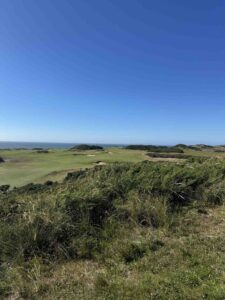 Pacific Dunes’ unspoiled, natural landscape added to the experience. The dense bushes, tall, thick grass and big bunkers made gauging the wind particularly strenuous. The property was hilly, too, which made Pacific Dunes a physical workout as well. Battling the conditions was really hard, and it was a one-of-a-kind experience. I’m very glad I braved it, though I wasn’t feeling great that day. I caught a bad cold just before going on the trip.
The views from the layout were beautiful, with several of the holes near the ocean, which made the wind seem like it was even stronger. Bandon Dunes is definitely a place to visit. Truly unique.
The course played hard and fast, too. The greens were speedy and not easy to approach, offering even more struggles to score. The holes that were into the wind played very long even though some of them were quite short. I learned the meaning of a “two-club wind”. For me, it might’ve been more than that.
Because I wasn’t feeling 100 percent – or even close – I didn’t try any of the food there. My playing partners ordered a snack and enjoyed it. It looked appetizing! They said the peanut butter balls were a must-try!
Overall, I’m not sure I would have scored better even if I was feeling my best. Pacific Dunes looks wide and open, but you really must hit your targets and distances to do well there. But regardless of the score, Pacific Dunes was absolutely worth the effort, and I’ll never forget my experience on the rugged Oregon coastline. I hope to go back!
The Pacific Dunes Course at Bandon Dunes Golf Resort
57744 Round Lake Drive
Bandon, OR 97411
Website: https://bandondunesgolf.com/golf/golf-courses/pacific-dunes-golf-course/
Phone: (541) 347-4380; Toll Free (888) 345-6008
Designer: Tom Doak
Owner and Visionary: Mike Keiser
Director of Golf: Jeff Simonds
Tees/Yardage/Slope/Rating – Scorecard values
Black 6633 138/72.6
Green 6142 134/70.3
Gold 5775 128/68.6 (L) 141/74.3
Orange 5088 128/69.3
Rates and Notes:
Rates are tied into packages based on hotel stays and duration of visit. Consult the website for further details.
Fees include all the range balls you’ll ever want, and access to Bandon Dunes’ 60-acre practice facility (designed by David McLay Kidd).
Carts not included! Pull carts are available, however (for no charge). We would not recommend anything other than carrying your bag or taking a caddy, however. All of Bandon’s courses are somewhat challenging to navigate, and the on-course marshals will keep you moving. They’ll switch over your huge cart/travel bag to a carrying bag upon request, and this is highly recommended. ‘Dragging’ the pull carts through the sand at Bandon Dunes is an ‘exercise’ in frustration as well as a thorough workout for your body. Not for the less than hearty.
Bandon Dunes is not your ultimate family vacation (at least with young children), and that should be taken into account when booking a trip there. If you’re there to play golf, there’s hardly anything better in the world – but for non-golfers, the pickings are somewhat sparse.
Consult the website for more information on accommodations and possible alternative attractions.
The Bandon Dunes staff was first-rate – everything you’d expect for this type of ‘pure’ experience. The resort and its golf are not inexpensive, but you’ll feel there’s good value there.
Caddies can be as helpful as you’ll allow them, or they can be an unwanted part of your bonding adventure. Discuss it with your playing partners prior to going there, though we would recommend that you try taking a caddy for at least one of the courses – if just for an experience/opportunity that you don’t get very often.