
By Jeffrey A. Rendall
Republicans hope against hope 2026 will not turn out how the 2006 midterm elections did
Where were you (almost) twenty years ago?
Everyone receives this type of query from time to time, but it’s usually associated with a shocking major event – like the Kennedy assassination or 9/11/01 terrorist attacks – or something that hits closer to home like a negative personal milestone that’s hard to put behind you.
But you probably wouldn’t place the 2006 federal midterm elections in quite the same league as those aforementioned life-changing occurrences. For conservatives, this likely is due to the fact that, if you recall the mid first-decade circumstances at all, you associate them with something disagreeable and maybe even painful, a time where Democrats took advantage of the doldrums in the middle of George W. Bush’s second term, a period when conservatives felt more betrayed than gratified by what the amnesty-pursuing Republican president did.
Don’t strain your brain trying to place what transpired at the time. Bush narrowly won the 2004 election (though he did prevail in the popular vote), he immediately announced that he would devote a chunk of his “political capital” to attempting to restructure the hopelessly broken Social Security system, and then… well, Hurricane Katrina struck the gulf and New Orleans was temporarily sunk under surging water when a dam (Lake Pontchartrain) failed near the Louisiana bayou city.
Though the category 5 cyclone devastated the South a year before the 2006 federal midterm elections, the minority party Democrats were imminently successful in branding Bush and his administrators as racially biased and uncaring because most of the victims in the beleaguered region were not white. Bush’s federal executive departments dumped billions into helping/rescuing New Orleans, yet the damage to the president’s political reputation proved impossible to overcome.
Yeah, there was the Iraq War, too. It showed no signs of ending – or even winding down – and Americans were in a foul mood. They were war weary. So much so, they turned the Bush-fronted Republicans out of power.
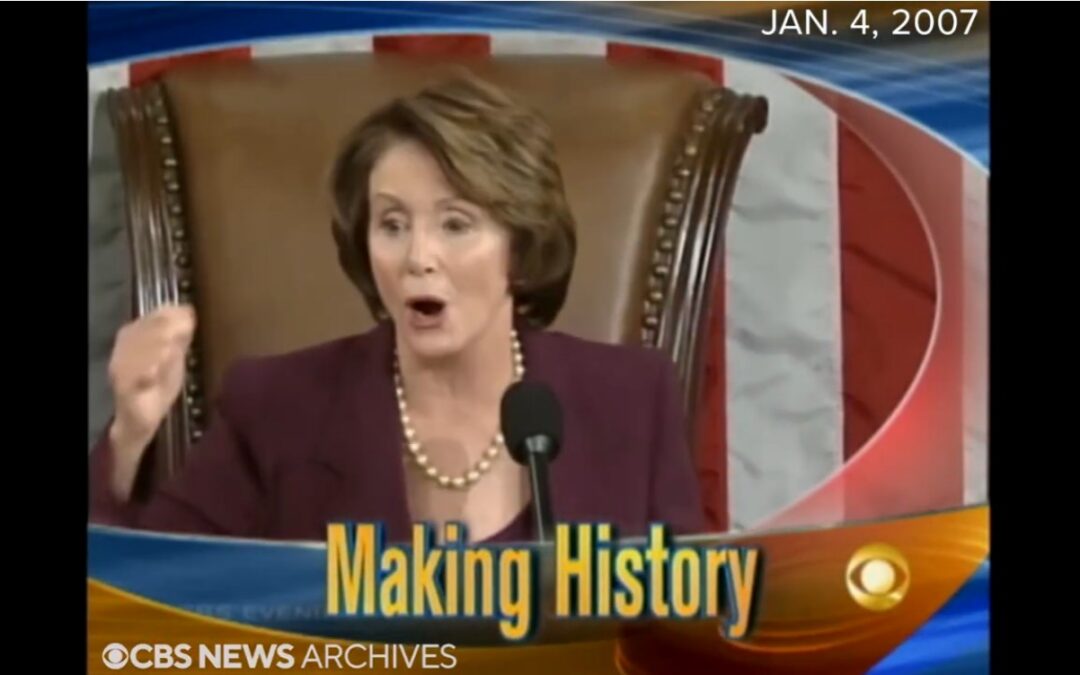
Democrats took over. Nancy Pelosi became Speaker and the country was never the same afterwards. No need to mention Barack Obama here, but he’s tied into all of the hubbub, too.
Will it be déjà vu all over again in 2026? As would be expected, contemporary American politicos are pondering whether this year’s rapidly approaching midterm votes will turn out much the same way as twenty years ago.
In an article titled, “Shades of 2006? What this election does, and doesn’t, have in common with Democratic wave 20 years ago”, W. James Antle III wrote at the Washington Examiner last week:
“Republicans hope a favorable map and hefty campaign war chest can compete with objectively bad national conditions this fall. Democrats are hoping those conditions, driven in part by Trump’s job approval rating, which just hit a second-term low in the RealClearPolitics average of polls, will expand the number of competitive seats to their benefit.
“The other potential distinction is the rise of socialism among Democrats, with Abdul el Sayed winning a Senate primary in a battleground state just [last] week. The Democrats’ brand remained poor in most polling before socialists started winning primaries. It may prove a bridge too far for at least some voters this time around.
“Other than that, there is little reason to expect Republicans to defy history this year. The party that holds the White House has lost congressional seats in all but two midterm elections dating back to 1938. They just have to hope it won’t be the ‘thumping’ Bush described after the party’s losses in 2006.”
The highly respected Antle neglected to mention one key distinction between this year and 2006, that being Donald J. Trump is president now as opposed to the eternally wishy-washy establishmentarian George W. Bush two decades ago. Trump came in to put an end to wimpy Republicanism under the Bush-headed Republican establishment, and he’s largely been effective in doing so.
Here’s thinking Bush wasn’t personally unpopular in 2006, but his policies were. Voters didn’t like the long Iraq War, the “Mission Accomplished” banner Bush became inexorably linked with, the Abu Ghraib prison controversy and, as mentioned above, the aftereffects of Hurricane Katrina. Bush didn’t have a useful political answer to any of these challenges, and Democrats, being who they are, exploited every last opening to capture the reins of government.
I remember listening to the Rush Limbaugh radio show during that exasperating time and the conservative icon trying to put the best possible spin on the Republicans’ forlorn campaign efforts in 2006. It didn’t work. Not even Limbaugh could convince voters that the Republicans hadn’t wholesale tossed conservative policies in the round file under Bush. And the GOP paid the price.
Now, however, Republicans have President Trump in charge, and Trump is a much stronger force than Bush was. Trump would not have presided over something as disastrous as the Katrina recovery, and he would’ve used his business background and commanding personal style to take hold of the narrative in a much more operational way.
Conservatives like Trump; they weren’t fully onboard with how Bush handled things, though. They still backed Bush because he was marginally better than the Democrats, but there was a decided lack of enthusiasm for extending Bush’s agenda. As Election Day drew nearer, we had a sinking feeling in our guts. It was tangible.
Is it the same today? The president himself doesn’t project an aura of hopelessness like Bush 43 did.
This isn’t to say Trump is perfect. “Bush’s brain”, the now utterly discredited Karl Rove, argues that Trump is mishandling the party’s messaging operation in 2026. Rove said (as reported at The Hill last week), “Rove agreed that the underlying data is positive, but said Republicans are making a mistake by emphasizing economic statistics that many voters do not believe reflect their own financial reality.
“’I think more could be done,’ Rove said. ‘Look, you cannot do — and we are doing right now what Joe Biden did [in 2024]. ‘Everything’s great.’ You know, we can’t go out and say, ‘It’s the best economy the world’s ever seen.’ That’s not what people are feeling. What we’ve got to remind them is that we’ve taken steps to make it better, and those steps resonate with ordinary people.’”
Far be it from me to state that Rove is right – and Trump is wrong – but I agree with the former Bush political strategist on this one. As I’ve argued recently, pounding home a “This is the best… everything” line of persuasion doesn’t resonate with the average person who goes to the gas station and the super market and thinks, ‘This is NOT the best we’ve ever had it.’
Trump gave a speech in Las Vegas last week where the president reiterated how “great” things are right now. If you look at the objective economic numbers, things do look wonderful indeed. But I doubt people will say to themselves, ‘Well, business investment is way up and the Labor Department says wages are going up faster than inflation, so I’m going to vote Republican to keep the good tidings rolling.’
That’s not the way it works in the highly volatile world of politics. We’re talking about a tiny slice of undecided voters here, not the small business owners who have noticed that they’re getting more business and consumer spending is going up as well.
The average person hears the Democrats obsess over the Iran War and gas prices and “affordability” and they’re trapped in a time warp where they’re even considering putting Democrats back in charge. It’s counterintuitive to be sure, yet human nature is human nature, particularly where politics enters the equation.
Those of us who live in Virginia witnessed the phenomenon first-hand last November. Will history repeat itself on a national scale this time?
With redistricting, etc., the picture becomes foggier. All I know is the “everything is great” message didn’t do much to stave off a disaster for Republicans in a commonwealth that, not too long ago, had every state constitutional office filled with a GOPer and was close to even numbers in the legislature, too.
Now we Virginians are stuck with Abigail Spanberger as governor and dedicated leftists as lieutenant governor and attorney general as well. The Virginia legislature? Don’t ask.
I don’t hope this year will be like last November, and I surely don’t want 2026 to be like 2006, either. Time will tell if the historical trends repeat. But Republicans should be working extra hard to address the mood of the country and tailor their message to match. That’s the only way we won’t have to think about “Where was I twenty years ago?” in 2046 in an unpleasant light.
Jeff Rendall is editor and publisher of GolfintheUSA.com and has written about golf and politics for over a quarter of a century. A non-practicing attorney from California, he moved to the east coast three decades ago to pursue and combine his interests in all things American history and culture. Jeff has worked as an intern on Capitol Hill and in various capacities in grassroots organizing and conservative organizations and publications, including a nearly two-decade stint at ConservativeHQ.com. Column republishing or other inquiries: Rendall@msn.com .