
By Jeffrey A. Rendall
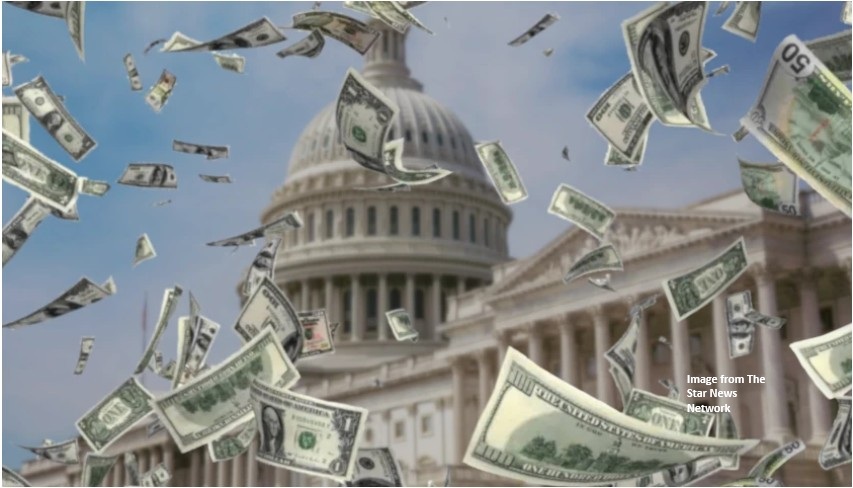
Politicians would rather talk Trump’s Social Media flareups than tackle dollars and cents
Hardly anyone mentions it anymore.
The “it” being the national debt and the massive pile of red ink our federal government accumulates on a minute-to-minute basis. Or more like at micro-second to micro-second intervals. And does red ink really stack?
It does when the liquid is used to print ledgers and balance sheets, the stuff official bean counters employ to attempt to wrestle with a beast no one can control. Or few seem willing to try to contain. That’s a better way to depict it.
Kentucky Republican Senator Rand Paul has tried, somewhat relentlessly – and fruitlessly — to bring attention to the debt problem. Paul regularly withholds his vote from party colleagues looking to pass spending measures, carrying on the family tradition that father “Dr. No”, Ron Paul, established last century by steadfastly refusing to join the crowd in assenting to rapidly escalating federal outlays.
In this, Senator Rand is right, even if his intransigence isn’t making the overall political situation any better for himself or his party. The lone voice crying in the swamp wilderness doesn’t have much impact in these days of wild over-exuberance for spending taxpayer money the creatures don’t have. The debt accumulations are getting so large that they require math PHD’s to figure them out. Or philosophy students to debate if there’s an invisible barrier to prevent them from going higher still.
Yet as bad as the problem appears, one group suggests the powers-that-be aren’t being contrite about just how enormous the national debt really is. In an article titled, “National Debt over Four Times Greater than Reported, Accounting Group Says”, Thérèse Boudreaux reported at The Center Square (in the Star News Network) recently:
“… Truth in Accounting included all of the federal government’s unfunded obligations in its debt assessment, including unfunded promises like Social Security and Medicare benefits. As of Sept. 30, 2025, the U.S. government had only $6.1 trillion on hand to pay for $176.3 trillion worth of incurred and promised liabilities, Truth in Accounting reports.
“Within that number, projected Social Security benefits for all Americans who have entered the workforce amount to $54 trillion, total Medicare benefits will cost $74.5 trillion, and military and civilian retirement benefits will be $15.5 trillion. Truth in Accounting based its analysis on the most recent federal audit of the U.S. government, which does not include the net $170.3 trillion in national debt calculations because it believes the public promises of future benefits are non-binding.
“’The government does not believe that it owes anybody any Social Security or Medicare benefits beyond next month, because they believe that they can pull them back at any point in time,’ Truth in Accounting founder and CEO Sheila Weinberg told The Center Square.”
Yeah, sure. Like Congress would ever get its act together and pull anything back – especially spending. Congress can’t even agree on paying salary and benefits to DHS employees who, through no fault of their own, were entangled in a politics-only struggle between Democrats, who enjoy creating spectacles for no reason, and Republicans, who gripe and whine and complain but won’t do anything about the stupid filibuster to unclog the jam.
As if this weren’t pathetic enough, the above-referenced article stated, “To close that shortfall, the federal government would have to tax people an additional $170 trillion over the next 75 years in order to fund those benefits. Divided equally, that amounts to an extra $1.1 million per U.S. taxpayer.”
Wow, that’s a hefty sum. I was only average at math during my schooling years, but I did learn how to add stuff up. And multiply. And divide. Any way you see it, the government owes a lot of money to millions of people and yet it still keeps spending and spending and spending and talking and talking and talking and not doing much to fix things.
Didn’t we used to call the practice “stealing from the Social Security Trust Fund”?
President Donald Trump, for all of his many issue position attributes and second-to-none advocacy skills, doesn’t pay much heed to the government’s bottom line that he’s so liberally expanded. Trump pushes for tax cuts and spending at the same moment, so much so that the Laffer Curve doesn’t have time and opportunity to catch up with the outflow.
Trump entered politics with a philosophy that entitlement cuts were completely off the table to begin with, and he’s more or less kept this vow as chief executive. Most congressional Republicans have gone along with Trump’s budget management theories, preferring to kick the already-severely dented debt can down the road without stopping to think a whole lot about what it means to the average citizen.
Add the cost of Trump’s various military excursions to the tally and America has accumulated a ponderous chain of debt. COVID’s years’ worth of bloat is barely a distant memory, too. Remember the “emergency” spending Congress shoveled at the states in a futile attempt to contain the tiny Chinese virus?
How about Obamacare? Most states accepted the Democrats’ original bribe and expanded their Medicaid eligibility rolls. As predicted years ago (by the responsible people), Healthcare expenses have skyrocketed and there’s little hope that doctor visits and hospital stays will go down in price.
Up, up, up it goes. Where it stops, nobody knows!
For his part, President Trump offers revenue gains through tariffs as one means to close the annual debt gap. Due to inevitable economic growth, tax receipts will eventually rise under the One Big Beautiful Bill Act, too. Trump’s advocacy for energy exploration is another way to raise proceeds. It makes sense, if we’ve got the stuff in the ground, why not bring it up and sell it?
There are ways to bring in additional returns without raising taxes. These surely include ongoing attempts to discover and squelch fraud. Cracking down on illegal immigration will also aid in the effort. Some incremental reforms in welfare expenditures will also move the needle. A bit.
One example is when Vice President JD Vance announced on social media that his task force acted on fraudsters in the Los Angeles area that had stolen “$50M+” from U.S. taxpayers. These people had apparently ripped off healthcare and hospice money by creating a scheme to bilk the ignorant and unsuspecting government.
These things are all well and good. And the work needs to continue. Last year’s lessons from DOGE have not been forgotten. But these are small-ball victories when so-called big-ball wins are vitally required, the types of spending improvements that can only be accomplished through budgeting and congressional actions.
We need trillions in savings. Millions are terrific, but it’s not gonna solve the dilemma.
Meanwhile, establishment media talkers prefer homing in on Trump’s latest social media semi-rants and how many bombs have hit their targets in the Middle East. And whether America should be “over there” at all and placing men and women in harm’s way even though U.S. casualties have been surprisingly light compared to other shooting conflicts.
The potential long-term benefits of these types of military engagements don’t receive much discussion. Neither do the fiscal rewards. If there are any to quantify.
These are real-world dilemmas the country will need to confront one day. The unfunded mandates of America’s entitlement programs will continue to be there until someday, someone on Capitol Hill – and the White House – decides it’s time to stop arguing over puny matters like paying DHS employees and switch to hashing over the BIG budget numbers.
Somebody other than Rand Paul and a handful of Republican House members needs to jump into the conversation. It’s understandable how politicians hesitate to put their names on proposals to cut federal spending, but why isn’t there a greater impetus to enact something like Paul’s “Penny Plan” which would reduce department and agency budgets by 1% a year until the budget is balanced?
This is almost too simple to dispute. What Republican officeholder would lose his or her seat because he or she fought to reduce spending by so little? Would anyone even notice?
Rather than worry over entitlement program eligibility or increasing the minimum age, why not summons the political will to work on – and then pass – laws that install new ideas on ways to lower citizens’ healthcare costs? Haven’t we been talking about selling health insurance across state lines for well over two decades now?
It’s no wonder that no one wants to talk about the budget and the national debt. The subject is entirely too depressing and the solutions too unpleasant that encouraging politicians to wax on something other than the “shiny object” topics is almost impossible. Trump could truly cement his presidential legacy by leaving a country on sound budgetary footing.
Jeff Rendall is editor and publisher of GolfintheUSA.com and has written about golf and politics for over a quarter of a century. A non-practicing attorney from California, he moved to the east coast three decades ago to pursue and combine his interests in all things American history and culture. Jeff has worked as an intern on Capitol Hill and in various capacities in grassroots organizing and conservative organizations and publications, including a nearly two-decade stint at ConservativeHQ.com. Column republishing or other inquiries: Rendall@msn.com .