By Jeffrey A. Rendall
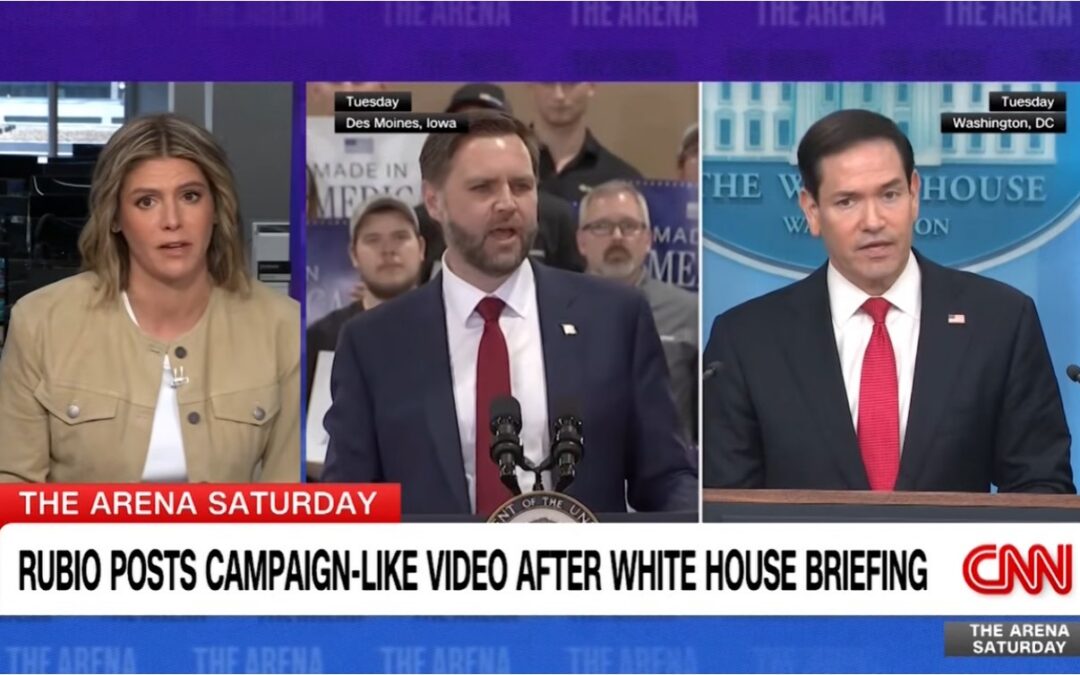
JD Vance or Marco Rubio has a better shot to win in 2028? One has a slight advantage
Calendar watchers see we’ve reached the end of August and are about to crossover the Labor Day campaign threshold for the vitally crucial 2026 midterm election cycle.
The summer’s passing hasn’t revealed much movement on the major political issues of the day. The Independence Day holiday now feels as though it was a long time ago, and folks are more preoccupied with settling the kids and grandkids back at school and concentrating on Fantasy Football drafts for the upcoming NFL season rather than obsessing over the week-to-week or month-to-month microscopic fluctuations in the presidential polls.
As has been noted in this space before, Republicans appear to have an uphill climb towards securing enough congressional seats to maintain their majorities going into next year, this despite assurances from a number of “experts” who foresee the logistical and practical barriers for Democrats as being too much to overcome.
The primary season has ended. Political pros will presently switch their emphasis to get-out-the-vote efforts and trying to pinch every last ballot for their side. A lot can happen between now and November, but the trends are established.
Not many politicos are paying close attention to the 2028 race yet, though President Donald Trump’s approval rating and personal preference foreshadowing draw quite a lot of comment whenever the Republican Party leader alludes to who he’d like to see succeed him.
The 2028 election feels like a lengthy slog from here, and with good reason, because it is a long way off. But is it ever too early to think about who will come after Trump on the Republican side?
Definitely not! In an article titled, “Rubio Edges Vance in 2028 Matchups with Dems: Poll”, Ben Whedon reported for Just the News (as published in the Star News Network):
“Secretary of State Marco Rubio appears to fare better against possible Democratic presidential candidates than does Vice President JD Vance, a recent survey has found.
“The latest Emerson College survey tested several hypothetical presidential races, pitting Vance and Rubio against Democratic heavyweights, including former Transportation Secretary Pete Buttigieg, Sen. Jon Ossoff, D-Ga., Gov. Gavin Newsom, D-Calif., former Vice President Kamala Harris, and Rep. Alexandria Ocasio-Cortez, D-N.Y. Against Buttigieg, Vance and Rubio both earned 44% support to Buttigieg’s 49%. Both Republicans earned the same level of support against Ossoff, though the Democrat earned 49% support against Vance and only 47% against Rubio. A Vance vs. Harris match saw him earn 45% to her 49%, while Rubio vs. Harris was 48% to 43%, respectively.
“Rubio managed to handily defeat AOC, earning 48% support to her 43%. Vance, meanwhile, still outperformed her, but by a narrower, 46% to 44% margin. In addition to this, the survey found President Donald Trump has a 40% approval rating.”
The numbers should give solace to a Democrat party still licking its wounds from 2024.
It should be noted the results of the survey are over a week old, and they’re only particularly noteworthy because it shows Secretary of State Marco Rubio besting Vice President JD Vance in one measure that may – or may not – matter a whole lot to Republican primary voters in early 2028.
Hypothetical inter-party head-to-head matchups mean even less than straight-up comparisons because they are, well, hypothetical, which means Republican candidate x may or may not be pitted against Democrat candidate y two years from now when the rubber meets the road at the outset of the 2028 general election campaign.
By Labor Day 2028, the party primaries will likely have been over for months, the party conventions will either have been hosted and concluded or just about to be held and finished up within days. And the parties’ respective spin machines will be in high gear seeking to put forth the most attractive arguments for keeping them in power – or evicting the Trump people from the vicinity of Washington, DC for the foreseeable future.
The more things change, the more they’ll stay the same. So, if Marco Rubio is currently a couple points better than AOC in a pretend matchup at this juncture, I doubt it’s worthy of celebration by the Republican party establishment. This will matter a lot when the time comes. The above referenced poll doesn’t mean much in the scheme of things right now.
So does it still have value?
Sure. The fact Rubio is currently ranked higher than Vance by a slice of the electorate is of prime importance in the “electability” category. People following the horserace closely have probably taken note that Rubio’s inched his nose in front of Vance when the both of them are put against prominent Democrats. That could be salient in a couple years.
But it should also be pointed out that Donald Trump often fared worse in hypothetical contests against Democrats in many instances prior to the actual balloting. There was many a pollster, for example, who revealed that Trump did worse against senile Joe Biden than establishmentarian Nikki Haley did prior to the primaries.
Yet Republican voters didn’t care about polling strength vis-à-vis Democrats when it came down to it, since they overwhelmingly chose Trump in all but a couple state primaries. (Note: Haley won Vermont’s GOP primary and also beat Trump in the District of Columbia, two “states” that wouldn’t provide their Electoral Votes to Trump in any scenario).
I also recall that Trump fared worse against several of his 2016 GOP primary rivals when his name was placed alongside Crooked Hillary Clinton’s in pre-Election polls. Yet the only one that mattered was on Election Day, when Trump scored the improbable political upset and beat Hill and Tim Kaine in the Electoral Vote tally.
Nonetheless, the fact Marco Rubio rates slightly better than JD Vance in races against Democrats probably indicates a few things:
First, JD Vance’s standing has taken a bit of a hit recently because of the ongoing Iran War and the perception among Americans that the Trump administration isn’t handling the top economic worries well.
JD Vance is not the man setting policy at the top echelons of government, but he’s often standing next to the president whenever a decision or position is discussed. Therefore, people see Vance and Trump as being the same person in nearly all respects. Trump won’t officially be on another presidential election ballot, but his aura will be there whether JD wants it there or not.
JD Vance’s political future is tied to the fortunes of the Trump administration, just as any vice president’s fate would be. Cackling Kamala Harris was hamstrung by senile Joe Biden’s infirmities during their one term in office, and she couldn’t crawl out from under them in 2024 despite the best efforts of the Democrat spinmeisters to make her sound authoritative. It’s just the way it is.
Second, Marco Rubio benefits from not being regarded as the frontrunner at this moment in time.
Until now, most of the attention on the Republican presidential race has been on JD Vance and if President Trump will give his “endorsement” to his vice president this far out from the waging of the campaign. Therefore, Rubio has kind of coasted under the turmoil and is seen by many as more “moderate” and tempered and “electable” against Democrats.
Rubio also can count on a big slice of the “anyone but Trump” portion of the electorate in both parties. Vance, on the other hand, is considered to be near to Trump and would merely sustain the current direction of the administration in their estimations.
Marco is close to Trump, too, but is far enough removed to win the favor of those who are sick of the president and just want a change. The fatigue factor, for now, is real.
Lastly, the survey is notable because it shows no Democrat has emerged as a runaway frontrunner on their side, either.
Early x vs. y polls usually show Democrats ahead, so that in itself isn’t worrisome for Republicans. Democrats will probably have a rather drawn-out selection process for their nominee, a fight that could easily get heated and nasty if it boils down to an establishment vs. Democratic Socialist-upstarts for supremacy.
Both Rubio and Vance – or whomever Republicans choose – would possibly gain from continued turmoil on the Democrat side. Time will tell.
Judging by the volume of campaign ads we’ve been subjected to over the past several weeks, election season is upon us and about to reach high gear after Labor Day. The 2028 presidential horserace is still in its opening stages. The race to become the next president will begin in earnest early next year. Keep an eye on the possible candidates. It will be fascinating to witness.
Jeff Rendall is editor and publisher of GolfintheUSA.com and has written about golf and politics for over a quarter of a century. A non-practicing attorney from California, he moved to the east coast three decades ago to pursue and combine his interests in all things American history and culture. Jeff has worked as an intern on Capitol Hill and in various capacities in grassroots organizing and conservative organizations and publications, including a nearly two-decade stint at ConservativeHQ.com. Column republishing or other inquiries: Rendall@msn.com .