
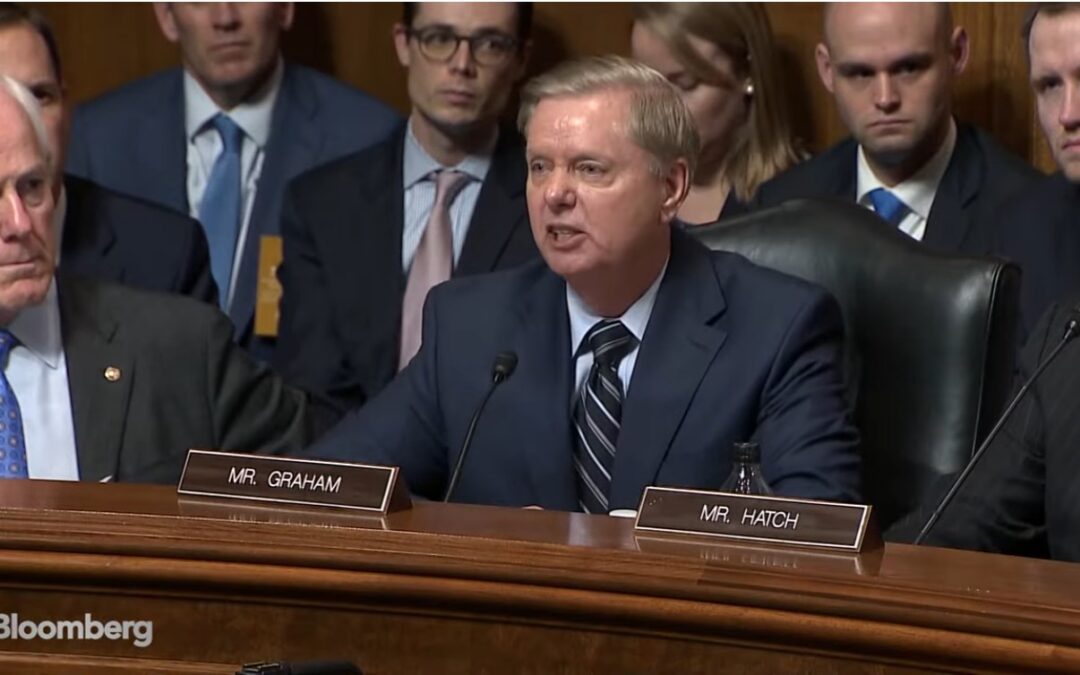
By Jeffrey A. Rendall
Lindsey Graham’s death leaves the political world stunned and worried about the future
In recent conversations with a family member regarding former President Donald Trump “haters” who subsequently saw the light and have since become fervent Trump supporters, South Carolina Senator Lindsey Graham’s name wasn’t part of the back-and-forth.
The senator, who passed away suddenly the other night, had been in Trump’s backer camp for so long as to cause people to forget that the earnest southern pol was once one of the 45th and 47th president’s fiercest 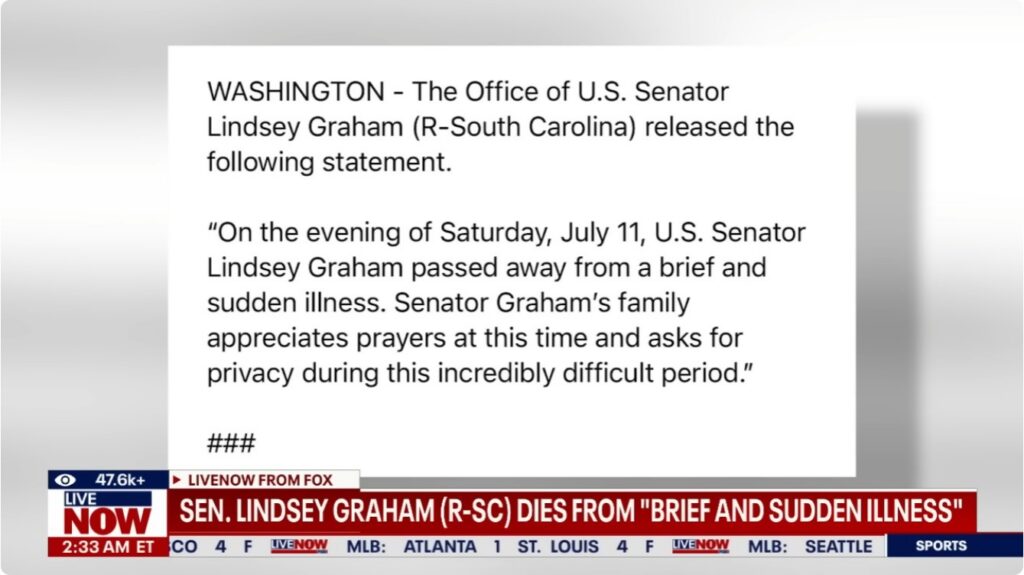 critics, or at least up until the time Trump was already well into his first term.
It seems like ancient history now, however, as the timing of Graham’s shocking demise will dominate politics discourse for the foreseeable future. Many if not most Americans had an opinion of Lindsey Graham. We’ll sort through the feelings as they emerge.
In an article titled, “Tributes pour in for Lindsey Graham after sudden death: ‘Lost a bold leader’”, the Washington Examiner’s staff reported:
“Sen. Lindsey Graham (R-SC) was celebrated by his Senate colleagues and others Sunday morning, after the news of his death Saturday evening.
“Graham died after a ‘brief and sudden illness,’ according to a statement from his office, and EMS radios showed reports of cardiac arrest. He had served in Congress for nearly 32 years. He was a U.S. representative from 1995-2003 and was then elected to the Senate, where he had served ever since…
“Sen. Tim Scott (R-SC), Graham’s South Carolina counterpart in the Senate, said he will be missed. ‘South Carolina lost a statesman and I’ve lost a friend,’ Scott said. ‘My prayers are with his sister and the rest of his family. From his humble beginnings to the Senate floor, Lindsey always led with faith, family, and South Carolina first. Lindsey remained committed to public service and doing what he loved. He always introduced levity and brought wit to the most challenging moments.’
Yes, indeed. Many of the public tributes to Graham referred to his sense of humor. Levity is often useful in today’s perplexing world, and Lindsey was renowned for lightening the mood.
I’ll be the first to humbly concede that, politically speaking, I was not always overly fond of Senator Graham, and, at different times, worked in my very limited capacity to have him replaced as one of South Carolina’s two senators.
For a good portion of Graham’s tenure in the senate, the optimistic upper chamber presence from the Palmetto State functioned as a rubberstamp go-along for the GOP ruling elites.
Looking back, fellow South Carolinian Senator Jim DeMint was held in extremely high regard by conservatives as a legislator who stood up and stood out when the going got tough. And when wasn’t the going tough during the Obama years? Rumors persisted prior to the 2012 presidential campaign that DeMint would disregard his multitude of public statements to the contrary and run for president.
It didn’t happen, and DeMint was out of the senate by mid-2013, his resignation clearing the way for Tim Scott to begin the next phase of his rags-to-riches political career.
But Graham was different. As a firmly established member of the RINO (Republican-In-Name-Only) contingent – and a great friend of the RINO-i-est senator of all, Sen. John McCain – conservatives didn’t fully trust Lindsey for his consistent championing of illegal immigration “reform” as well as his aggressive, neoconservative George W. Bush/Dick Cheney-backing foreign policy leanings.
This period was before the emergence of Donald J. Trump in the Republican Party. Trump quickly became known for his heartfelt and unrehearsed diatribes against illegal immigration, but he was just as celebrated (in some circles) for the New Yorker’s unwillingness to go along with the GOP’s tolerance of pro-offensive military adventurism/nation building. President George W. Bush didn’t have many friends remaining in the Republican Party (or anywhere else, for that matter) when the 43rd president left town, but Sen. Lindsey Graham was one of them.
The fact Graham was one of sixteen-or-so ambitious Republican presidential hopefuls in 2015 further positioned the South Carolinian against the Trump-ian onslaught, the institutional Senator calling Trump “unfit” for office and regularly making a spectacle of himself for embracing the Republican establishment brand while rejecting Trump’s fresh approach towards populism and breaking down barriers (or, with the border wall, building them up) to solving longstanding problems.
Graham went further with his anti-Trump observations, remarking on CNN, “He’s a race-baiting, xenophobic, religious bigot … He doesn’t represent my [Republican] party … I don’t think he has a clue about anything … He is empowering radical Islam … You know how you make America great again? Tell Donald Trump to go to hell… I’d rather lose without Donald Trump than try to win with him.”
Failing to earn a foothold in the 2016 race, Graham bowed out early (in December, 2015), and later indicated he didn’t even vote for Trump in the general election, explaining that he ended up choosing independent candidate Evan McMullin instead.
The two Republicans reconciled in the Spring of 2017, when Trump was president. Trump and Graham met and the meeting apparently went so well that they started playing golf together regularly and Graham’s tone towards the new president correspondingly improved, too. Trump’s categorical support for Israel, pro-military orientation and willingness to wage quick, aggressive strikes against enemies no doubt played a role in healing the divide between the two contrasting viewpoints.
But Graham’s sudden shift towards Trump was fairly typical of most Republicans once the lifelong real estate developer, tabloid celebrity and reality TV star revealed his penchant for policy and proved he not only belonged as president, but functioned as a second-to-none advocate for the types of political solutions that conservative voters wanted.
Like others, Graham discovered that the noise surrounding Trump was mostly media created and none of the “rumors” of Trump being an unrehabilitated serial womanizer, racist or partisan divider were accurate. Some Republicans, such as Liz Cheney, never reconciled with Trump, but most party members willingly hopped on the MAGA train once it left the station.
Graham’s practical about-face on Trump served as an important bridge between the new party figurehead and the establishment, which, it’s hard to recall now, used to carry great weight in the GOP. Skepticism of Trump’s political methods remained high among the elites, with Senator Mitch McConnell well-embedded as Senate Majority Leader and Paul Ryan firmly entrenched as Speaker of the House.
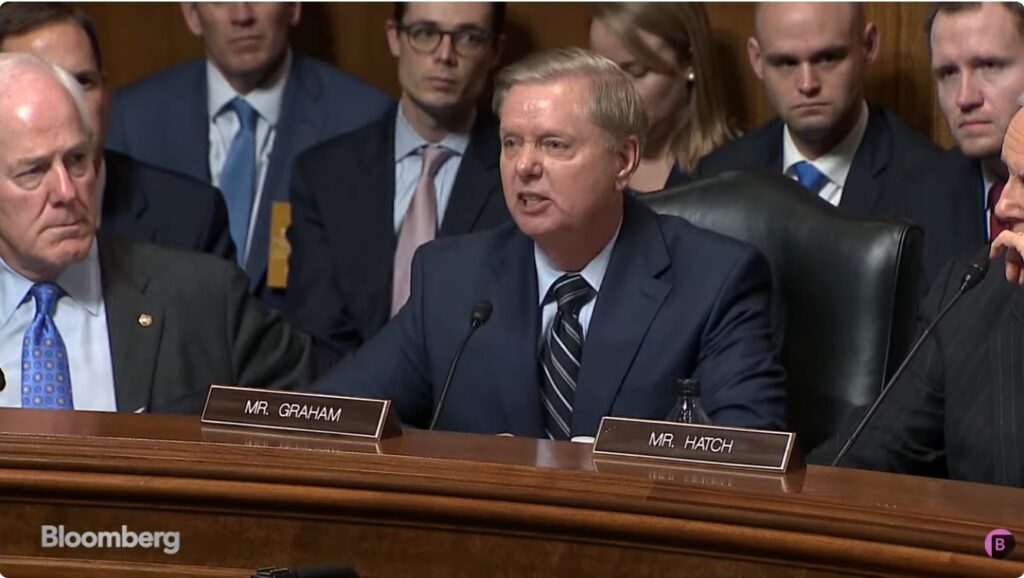
Upturns evolved slowly, but Graham’s finest moment came in 2018 during the confirmation hearings for Trump Supreme Court nominee Brett Kavanaugh. As if anyone needed a reminder, Kavanaugh was furiously opposed by the opposition Democrats, the liberal/leftist party honks – including then-senator Kamala Harris of California – pulling out all the smear stops to try and deny the ABA-approved nominee a seat on the high bench.
From the “I didn’t know you had it in you” category, Senator Graham’s finest moment arrived, a short but fierce defense of Kavanaugh and his family in front of the whole world, words that echoed (literally?) through the American political system and led to Kavanaugh’s close confirmation. The tone of the process altered when Graham spoke. Check out what Lindsey Graham said (click on the link):
The South Carolinian had endured more than his share of media-driven scorn himself, much of it from Republicans in his own tent. Graham’s championing of military adventurism and his outright advocacy for hammering out some sort of “fix” for the badly broken illegal immigration plague had semi-permanently left him on the outs with conservatives.
But Graham’s Kavanaugh moment cemented him with the conservative cause, and although conservatives didn’t always agree with him from then-on, at least we understood that Lindsey was a man of character and spoke his mind with passion and honesty. The lifelong bachelor devoted his years to public service and, at the very least, could be counted on to supply colorful quotes and an honest perspective on the matters of the day.
In the contemporary sense, Graham’s death will have few unanticipated reverberations for a senate that is already deadlocked on most important matters, including the ultimate fate of the SAVE America Act.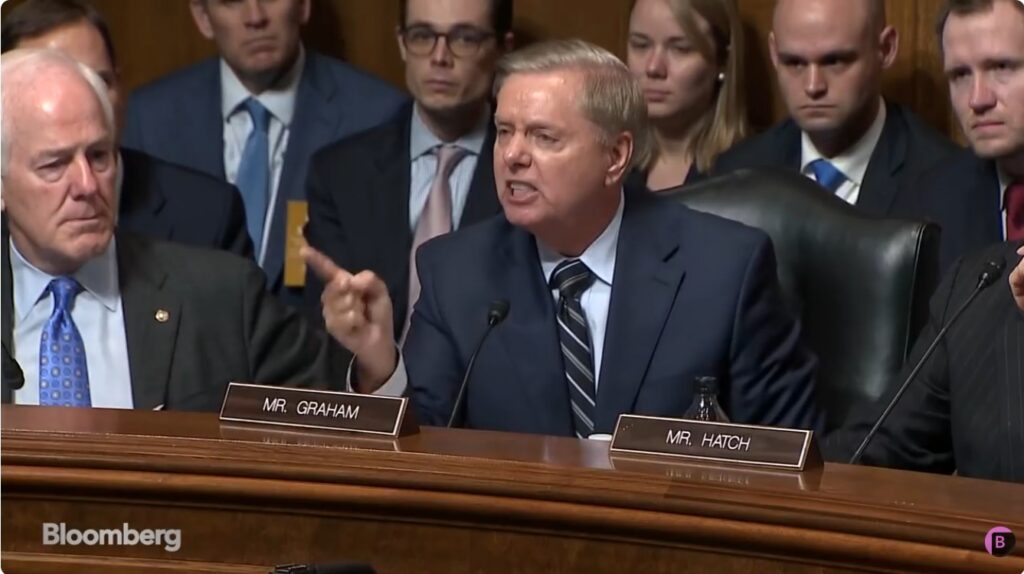
President Trump loses a friend and a respected, articulate voice in the Republican Senate Caucus. Common sense suggests Lindsey will be replaced (South Carolina law says a Special Election to choose a replacement for Graham in the state primary must take place by August 11th) by another Republican in the Senate, South Carolina being one of the reddest states in the solid red south. Graham’s
successor could conceivably be more effective on conservative causes, though the late senator rarely opposed something President Trump dearly asked for these days.
Here’s a story from the Washington Examiner yesterday that indicated that South Carolina Rep. Nancy Mace will vie for the newly opened senate vacancy. We’ll see.
Americans go through a period of reflection whenever an important person passes unexpectedly, and the numbness from Senator Lindsey Graham’s death on Saturday night will linger for some time. America lost a true original and the icon’s regular presence in political media will be sorely missed.
Jeff Rendall is editor and publisher of GolfintheUSA.com and has written about golf and politics for over a quarter of a century. A non-practicing attorney from California, he moved to the east coast three decades ago to pursue and combine his interests in all things American history and culture. Jeff has worked as an intern on Capitol Hill and in various capacities in grassroots organizing and conservative organizations and publications, including a nearly two-decade stint at ConservativeHQ.com. Column republishing or other inquiries: Rendall@msn.com .