
By Jeffrey A. Rendall, Photos by Jeff Rendall and Shari Rendall
Florence, Italy – Our underwhelming day in one of the most overwhelming city destinations on the globe. But we did see Michelangelo’s David
If you’re one of those people who’s looked forward to visiting a place for decades, you’ll understand what it was like for me to visit Florence, Italy, on the final day of our Mediterranean Cruise aboard Oasis of the Seas 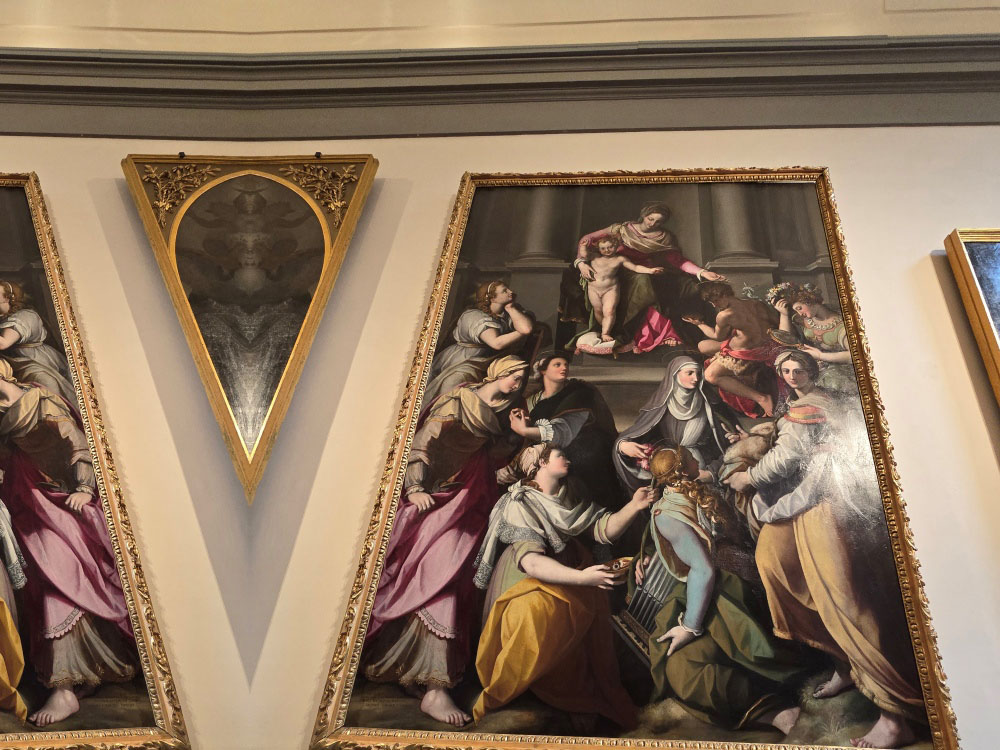 – and end up severely disappointed.
I’d looked forward to going to Florence with so much anticipation and expectations so high that it is only natural that I’d end up disillusioned with the actual day itself. But our problems with Florence stemmed from the way we’d planned the excursion rather than what we saw there. In a nutshell, we just didn’t see enough of Florence to truly grasp the enormity of the place. We made note of our mistakes and vowed to do better the next time if and when we get another opportunity to go there.
I can’t present a comprehensive look at Florence because our brief time in the city was anything but comprehensive. Simply put, we were treated to a nibble on the enormous pie of interesting things located there. Some of it was our fault for not doing enough research into how to approach a tour in Florence. Part of it was due to circumstances. And a big part of it was flat out choosing the wrong excursion. The rest is “history”. Live and learn.
1. Mistake number one – The cruise port is a long way from Florence itself.
One of the things you’ll realize right away if you opt to visit Italy as part of a weeklong cruise or tour that only devotes hours (instead of days) to your snapshot of these wonderfully historic destinations is… there just isn’t sufficient time to do anything thoroughly.
Or to absorb the history and information overload in digestible segments. Take whatever you’ve heard about the recommended time for any particular venue and double it, at the very least.
Where Florence is concerned, the first thing you should plan for is a lengthy bus ride from the cruise port to the city itself. We understood in advance that it would take some time to get from the ship to the heart of Florence, but what we didn’t grasp when plotting the course is just how much time would be wasted by the road trip to get there.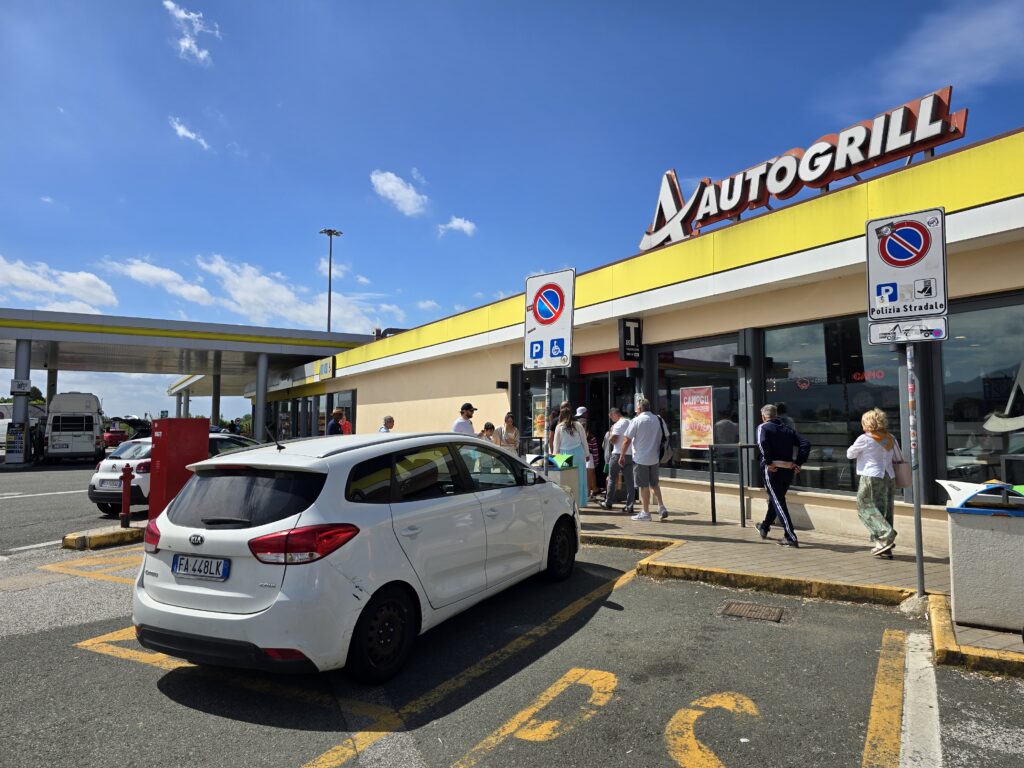
Maybe we were spoiled by the relative closeness of Naples to the cruise port, but we probably should have learned from the tedious drive from Naples to the Amalfi Coast that there just isn’t a quick way to get to some of these places. Making matters worse, the tour guide announced, early on in our overland journey to Florence, that there was a major accident in route, and that we’d be delayed by an hour or so.
Seeing as it was about a two-hour ride to begin with, that meant three hours inching along on a comfortable, air-conditioned bus. The Tuscan Italian countryside was beautiful and there seemed like there was a lot to look at. But we weren’t made aware of what we were giving up when the traffic robbed us of our allotted time in the city itself.
We’d booked the excursion though Royal Caribbean because we wanted to make sure the ship would wait for us if the tour ran late for some reason. This turned out to be a good decision, though there were so many tour groups that didn’t make it back for the 7 o’clock “all aboard” for Oasis of the Seas that there was no possible way the ship would leave without us. It had to be hundreds of passengers total.
The sail from the port that serves Florence was only a short distance from Civitavecchia, so this wasn’t an issue. We’d get back to Rome in plenty of time to catch outgoing flights.
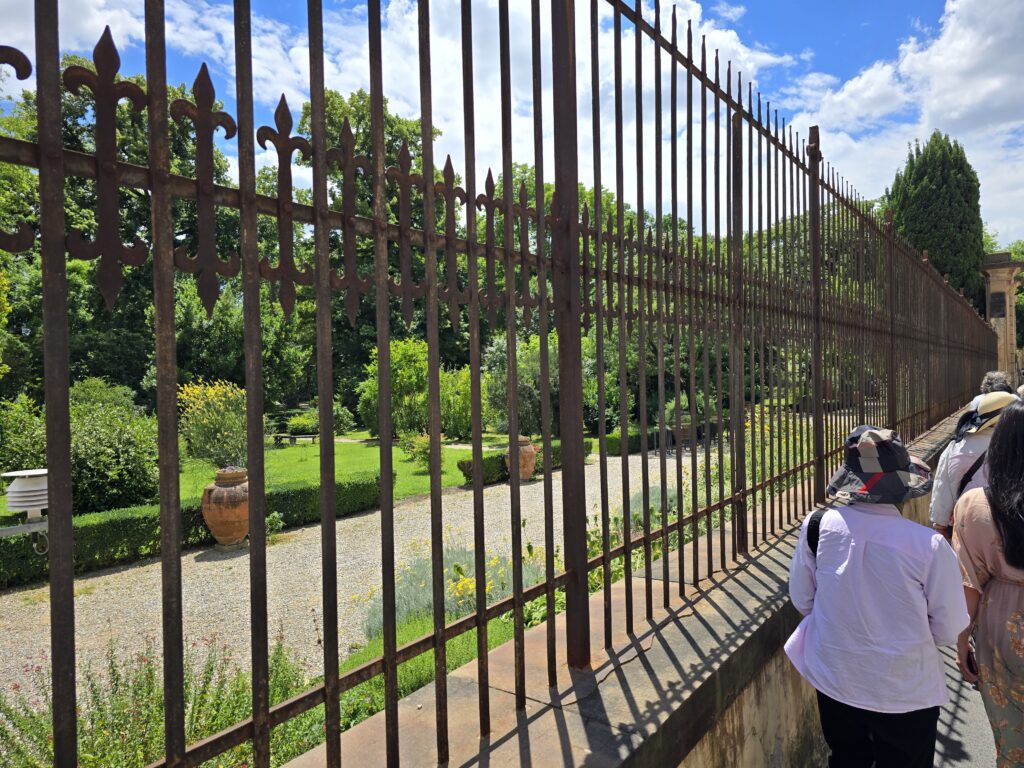 The tour guide did his best to pass the three hours from the port to the city, describing points along the way. There was acre upon acre of tomato plants on the journey and the view of the local hills/mountains was very memorable. If you buy a jar of Tuscan spaghetti sauce at the store, chances are, this was its place of origin. Who would’ve thought?
The tour operator built in a bathroom stop at a mini-mart (called AutoGrill) that looked as though it could be found in the states. The line for the women’s restroom was impressively long. The stop itself ended up taking about a half hour. I’m not sure if the delay helped the traffic jam clear or not.
It was almost surprising when the outer limit of the city was reached.
We were told that the bus would park some distance from the first “attraction”, which resulted in a rather lengthy walk. Like with Rome, the sidewalks were reasonably narrow, which made it a bit challenging to keep up with the pace of the group and stay out of the road. Florence had lots of Vespas buzzing around and parked using pretty much every available inch of space.
Part of the journey brushed up against a bike lane. There was a fair amount of construction in the vicinity, renovating the old or building new facades.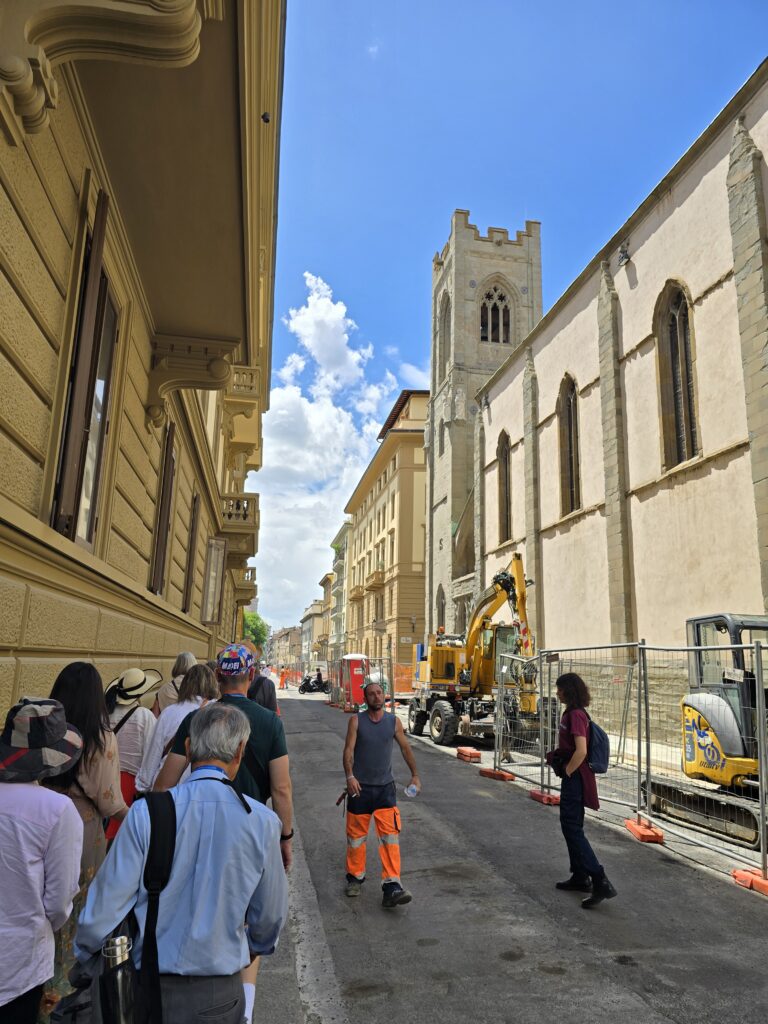
The tour guide didn’t dawdle. There wasn’t time for questions and answers. The day was quite warm/hot. We’d arrived, finally, but didn’t really have a moment to realize it.
2. This is what we came to Europe for: The Galleria dell’Accademia (Accademia Gallery) in Florence, Italy to see the original David sculpture.
The scene at the outside of the museum was utter chaos. It looked as though there were several lines that had formed, one for “normal” tourists and one for those with “Skip the Line” access, a designation that became essential for our first foray in Europe.
The noise and the language barrier added to the confusion. I had a hard time understanding what the guide was telling us, though was able to understand that we had to divide our group — #28 – into smaller segments. And that we’d have a new guide from the museum who would tell us what was what and point out various things along the way.
I could tell right away that the Accademia Gallery was a special place. The art works that were visible were extraordinary. This was like Disneyland for art lovers. The museum tour guide wore a microphone and each of us was provided a headset to attempt to hear her narration. I discovered that the headset only worked if we were in close proximity to 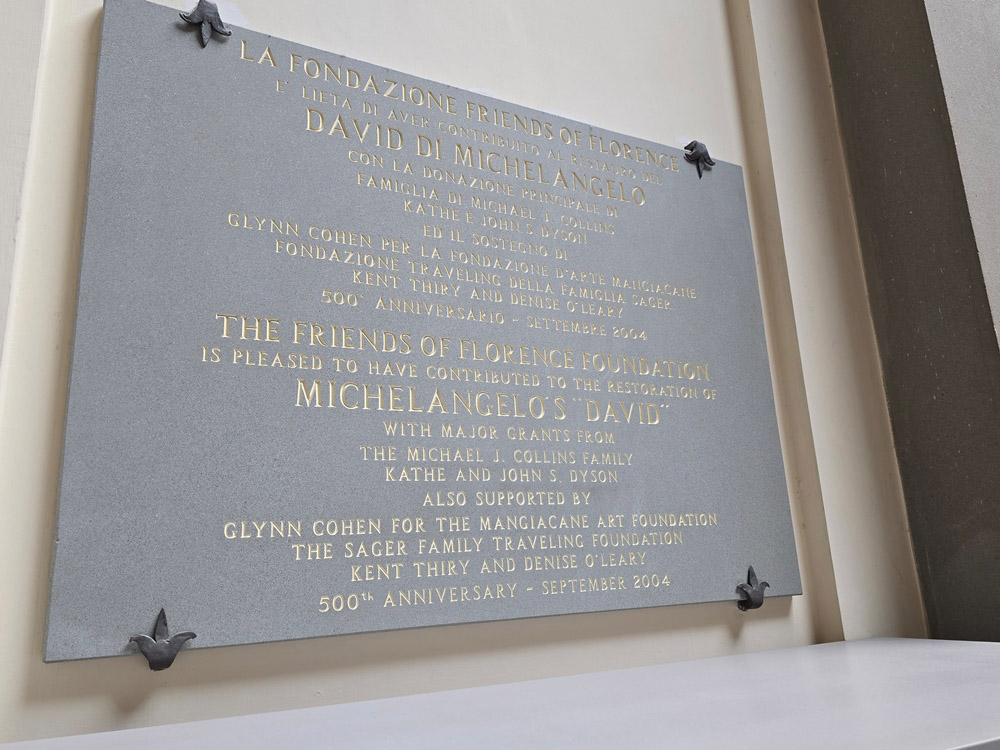 the guide, so if we were to get anything out of the experience, we had to stick close to her.
I’d stopped to try and examine a few of the Renaissance era paintings on the walls, not immediately recognizing the paintings or the listed painter. All the Italian names start to sound alike after a while. I harkened back to my college art class at Ucla in 1990, I think it was. I can still hear the lady professor’s pleasing British accent and I silently thanked her for instilling in me a love of classic art, whereas before I had none.
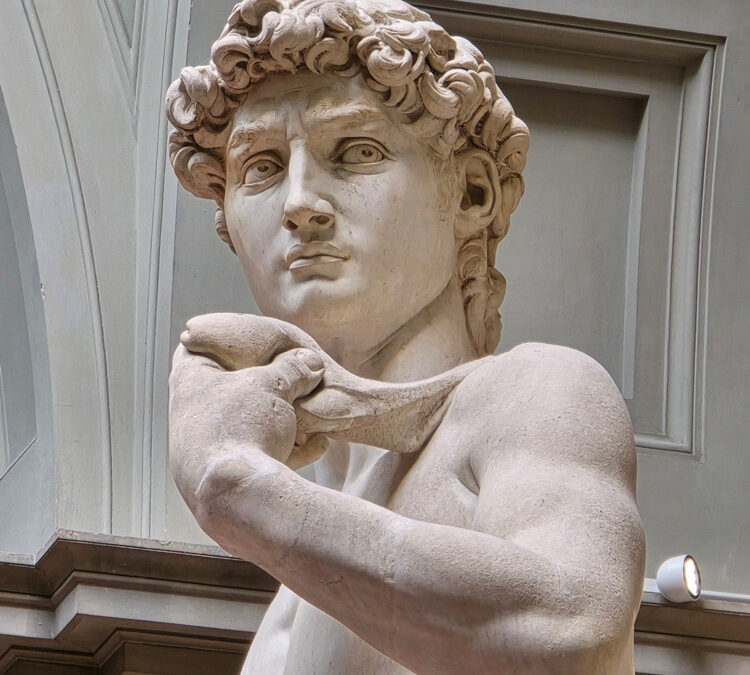
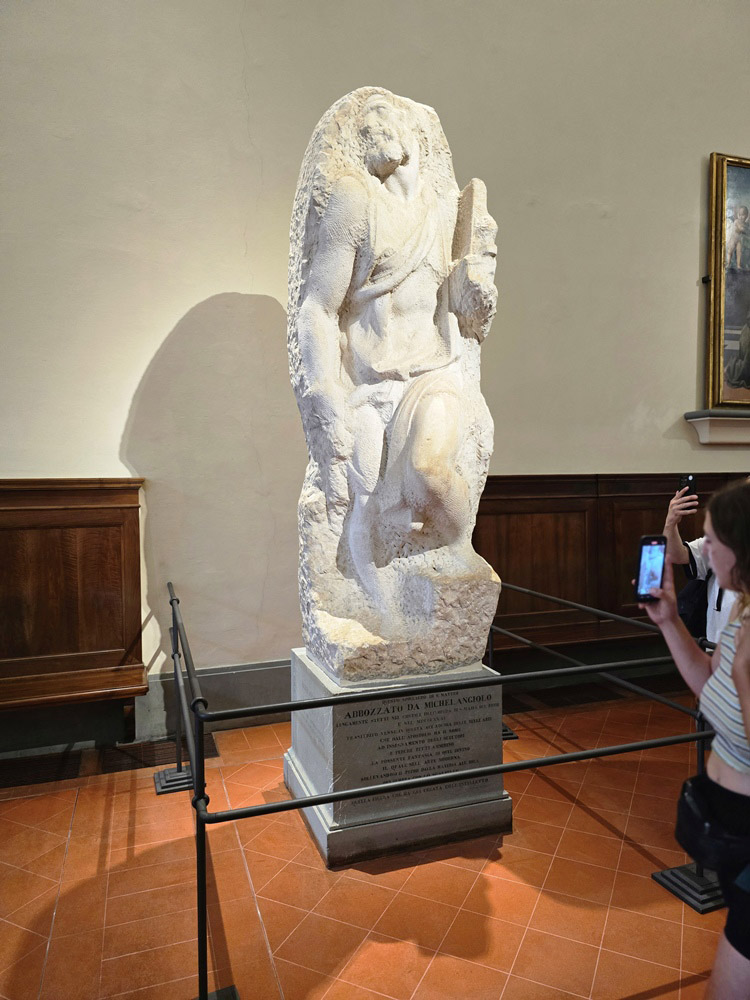
We were led to a long hallway that was packed with museum visitors. There were several unfinished sculptures from Michelangelo, which were fascinating in and of themselves, but the real draw, the actual David sculpture, could be seen in the distance, the masterpiece towering above the crowd.
The master had been working on the unfinished ones towards the end of his life and wasn’t able to complete them. You wouldn’t just toss ‘em out, right?
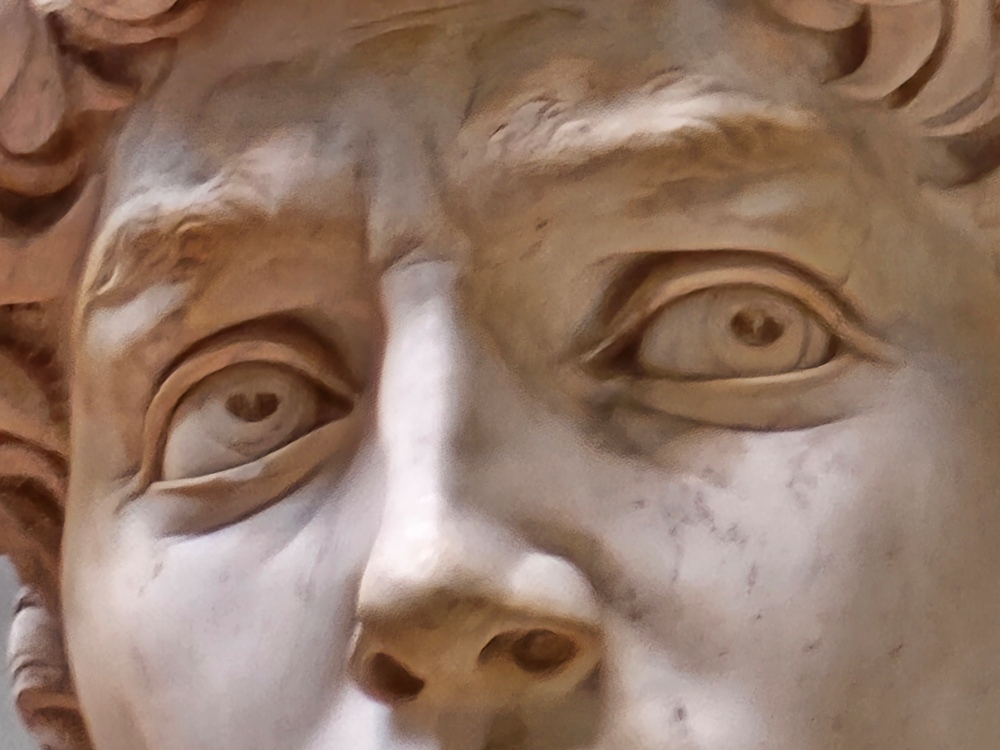
You don’t really realize how big the David sculpture is until you examine the scale of the work. “Impressive” is too simple a description.
“The big naked guy” is how I jokingly described David to a friend in my college art class, she having seen the real thing the summer previous back then.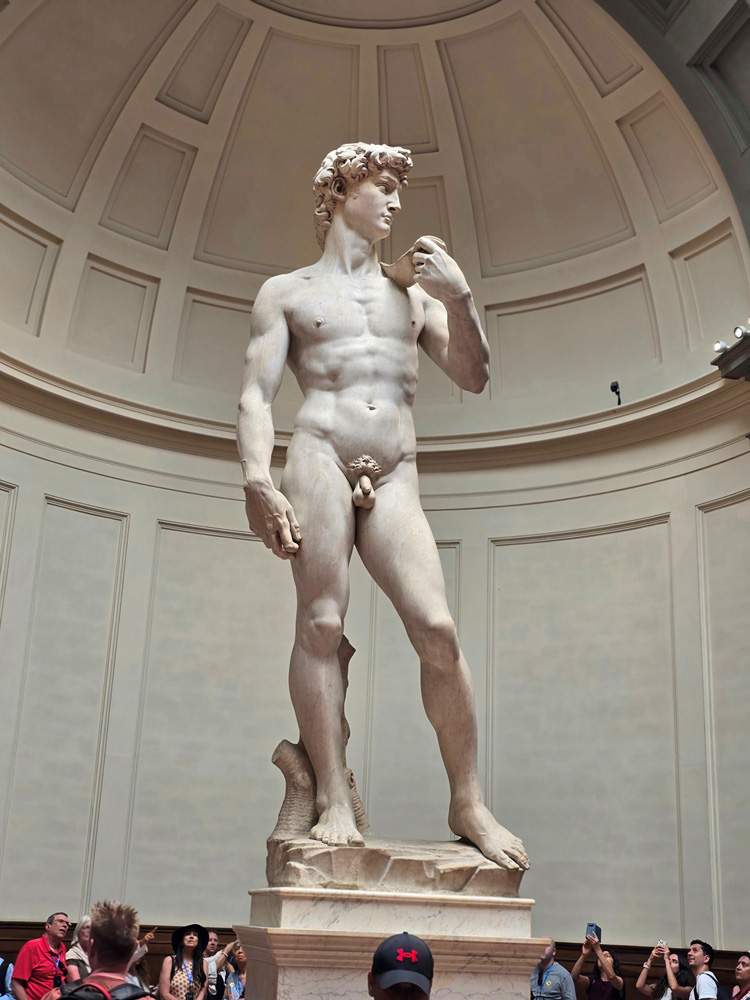
Well, there he was, in all his naked glory, Michelangelo having studied human anatomy to help him perfect his works, including studying corpses.
From Wikipedia: “David is a masterpiece of Italian Renaissance sculpture in marble created from 1501 to 1504 by Michelangelo. With a height of 5.17 metres (17 ft 0 in), the David was not only the first colossal marble statue made in the High Renaissance, but also the first since classical antiquity, setting a precedent for the 16th century and beyond. David was originally commissioned as one of a series of statues of twelve prophets to be positioned along the roofline of the east end of Florence Cathedral, but was instead placed in the public square in front of the Piazza della Signoria, the seat of civic government in Florence, where it was unveiled on 8 September 1504. In 1873, the statue was moved to the Galleria dell’Accademia, Florence. In 1910 a replica was installed at the original site on the public square.”
Thinking about it, I thought, “This is why we came all the way to Italy. This is It.” I wanted to see the David statue. An immense feeling of satisfaction came over me as I took a few long minutes circling the sculpture a few times, doing my best to hear the guide’s narration. And to understand her accent. It wasn’t easy, but we’d made it to Florence, and we were HERE, so how could you be unhappy?
My head hurt from concentration. I tried to absorb every little detail, figuring I might not get another opportunity to see this, to realize a dream, in effect. To set such perfection in marble. Unequaled. This was human talent at its apex.
I also surmised that Michelangelo had been working on David at about the same time he was working on the architectural blueprint for St. Peters in Rome. The Sistine Chapel ceiling was painted between 1508 and 1512. The master had just completed his Pietà sculpture (Virgin Mary holds crucified body of Jesus) prior to embarking on the David project.
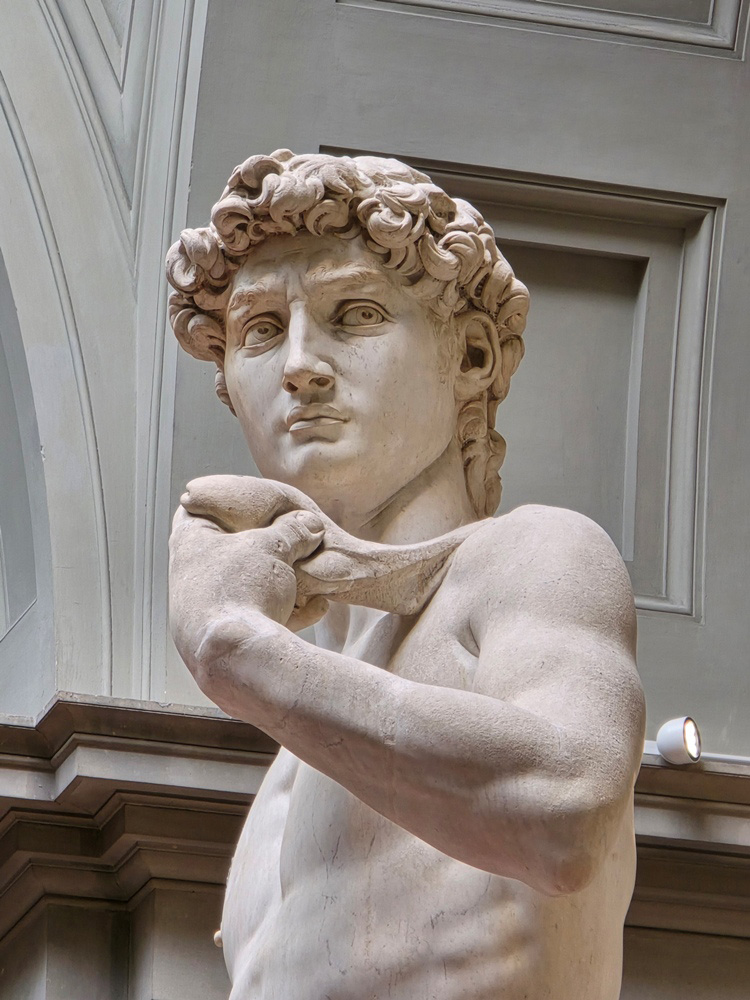 He was one busy dude. This was over 500 years ago, mind you. Talk about standing the test of time.
Peeling myself away from the chamber with the David statue, I wondered how we might spend the rest of the time at the museum, understanding that the wealth of art there was basically a once in a lifetime experience. Or, who knows, if we return to Florence, whether we’d want to devote time to seeing it again?
I didn’t quite know what to take pictures of. All of it was stunning. I was glad I wasn’t in art class any longer since I’d have a devil of a time telling it apart. But we were summonsed by our regular tour guide to the crowded area where we could do a bathroom stop and or visit the gift shop, and then it would be time to go.
Go? To what? Huh?
Seeing the David sculpture would normally be enough on many a vacation, but the Accademia Gallery’s immense reputation deserved more than about twenty minutes to appreciate like we were given. The traffic to Florence had robbed us of something valuable, and I think many of in the group were surprised – and not happy.
3. Do your research of Florence before you go on a tour. You’ll appreciate it later.
Not only that, we were directed to return to the hot outdoors where the tour guide held up his Royal Caribbean 28 sign, summonsing us to follow him in a non-voluntary game of follow the leader.
The sign led us down the now semi-densely packed avenue towards the square (Piazza del Duomo) where the large cathedral was located. I didn’t have a map, but I’d guess this place was the central gathering point for the city of Florence.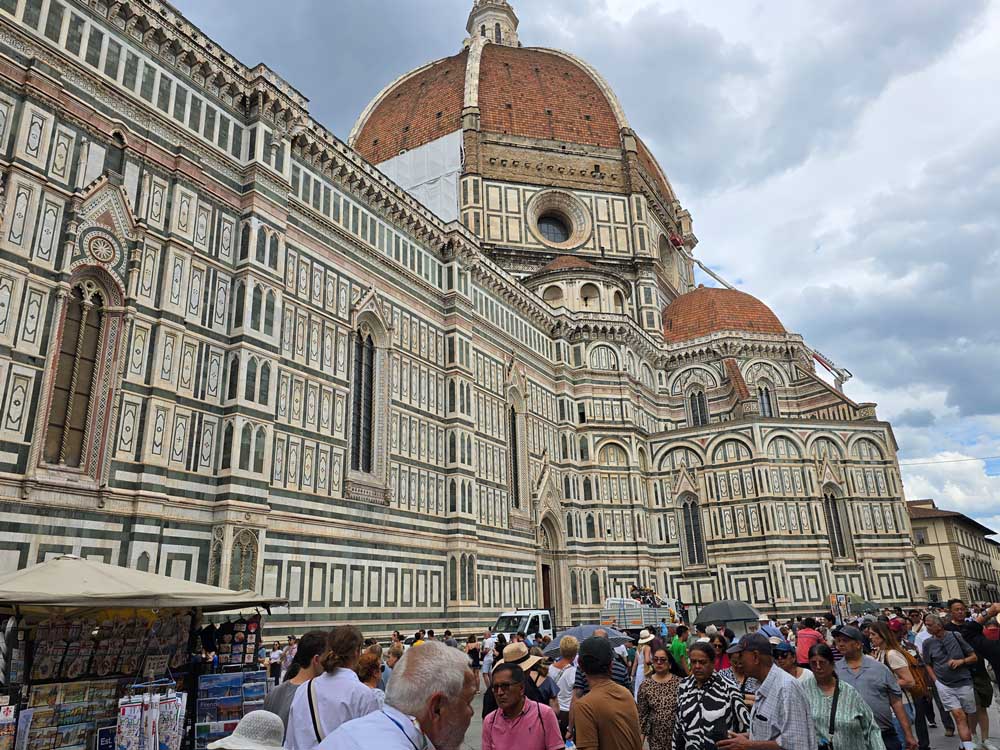
Whereas most visitors to Italy know at least something about Rome, Florence was a little more mysterious.
From Wikipedia, “Florence was a centre of medieval European trade and finance and one of the wealthiest cities of that era. It is considered by many academics to have been the birthplace of the Renaissance, becoming a major artistic, cultural, commercial, political, economic and financial center. During this time, Florence rose to a position of enormous influence in Italy, Europe, and beyond. Its turbulent political history includes periods of rule by the powerful Medici family and numerous religious and republican revolutions. From 1865 to 1871 the city served as the capital of the Kingdom of Italy. The Florentine dialect forms the base of standard Italian and it became the language of culture throughout Italy due to the prestige of the masterpieces by Dante Alighieri, Petrarch, Giovanni Boccaccio, Niccolò Machiavelli and Francesco Guicciardini.
“The city attracts millions of tourists each year, and UNESCO declared the Historic Centre of Florence a World Heritage Site in 1982. The city is noted for its culture, Renaissance art and architecture and monuments. The city also contains numerous museums and art galleries, such as the Uffizi Gallery and the Palazzo Pitti, and still exerts an influence in the fields of art, culture and politics. Due to Florence’s artistic and architectural heritage, Forbes ranked it as one of the most beautiful cities in the world in 2010…
“Florence originated as a Roman city, and later, after a long period as a flourishing trading and banking medieval commune, it was the birthplace of the Italian Renaissance. It was politically, economically, and culturally one of the most important cities in Europe and the world from the 14th to 16th centuries…”
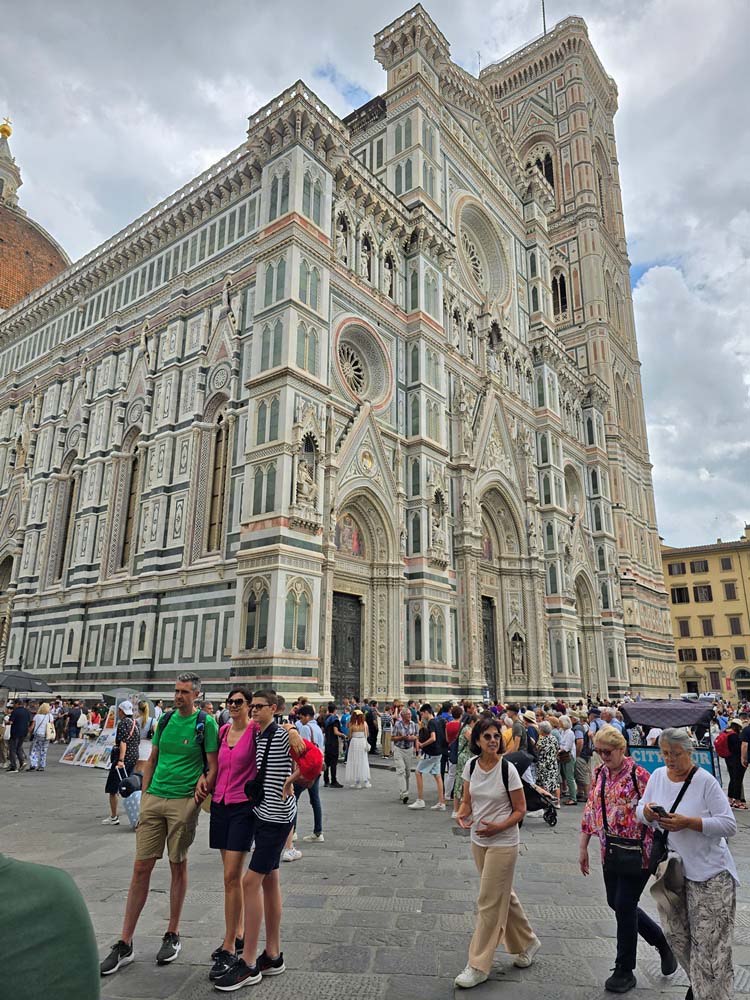 It may sound strange, but walking the streets of Florence, you can almost sense its significance. The streets are crowded with people, not cars or Vespas. Whereas I would normally avoid dense tourist attractions, Florence beckons you to want to see more.
The Florence Cathedral – or Cathedral of Santa Maria del Fiore is the centerpiece of the city center, with its amazing Gothic architecture and façade with statues and paintings. Not only that, the cathedral itself is huge – seemingly not as large as St. Peter’s Basilica in Vatican City, but almost as impressive.
The tour guide did his best to describe the Cathedral and the surrounding square’s important places, but one could take a college course on the subject and probably still not cover it all. The Cathedral was apparently open to the public, but we didn’t have passes or tickets and there simply was no time to explore further. The Florence City Center was the opposite of Barcelona, where the tour we chose provided an adequate guided narrative and a chance to see what we could before eventually deciding to leave.
Scaffolding obscured part of the domed Cathedral. One can only imagine how much sweat and toil it takes to maintain these treasures.
Sidewalk cafés dotted the area, which was very busy.
The dome itself towered over the city. Regarding the Cathedral, Wikipedia filled in the details: “Florence Cathedral (Italian: Duomo di Firenze), formally the Cathedral of Saint Mary of the Flower (Italian: Cattedrale di Santa Maria del Fiore [katteˈdraːle di ˈsanta maˈriːa del ˈfjoːre]), is the cathedral of the Catholic Archdiocese of Florence in Florence, Italy. Commenced in 1296 in the Gothic style to a design of Arnolfo di Cambio and completed by 1436 with a dome engineered by Filippo Brunelleschi, the basilica’s exterior is faced with polychrome marble panels in various shades of green and pink, alternated by white, and features an elaborate 19th-century Gothic Revival western façade by Emilio De Fabris.
“The cathedral complex, in Piazza del Duomo, includes the Florence Baptistery and Giotto’s Campanile. These three buildings are part of the UNESCO World Heritage Site covering the historic centre of Florence and are a major tourist attraction of Tuscany. The basilica is one of world’s largest churches and its dome is still the largest masonry dome ever constructed. The cathedral is the mother church and seat of the Archdiocese of Florence, whose archbishop is Gherardo Gambelli.”
To do it justice, a day probably isn’t long enough to explore the Cathedral and start to appreciate its artistic significance. But we only had about fifteen minutes, if even that long, as the tour guide said we had a lunch included with the tour.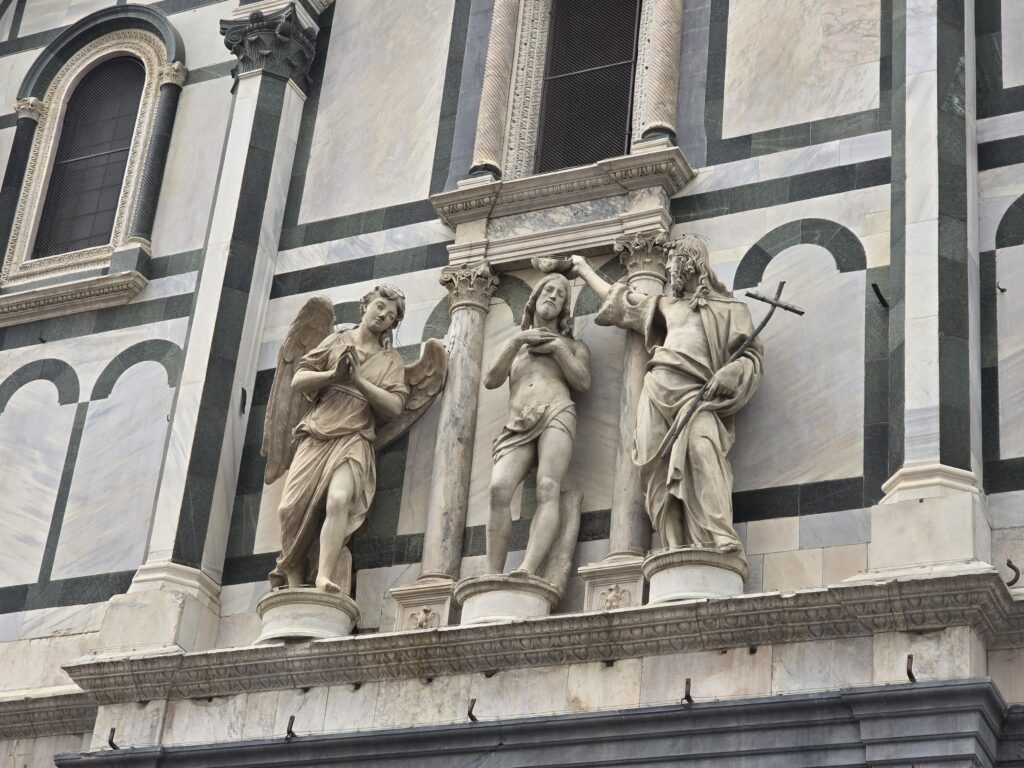
The idea of eating wasn’t unpleasant, but the museum stop had been incredibly short and now we weren’t provided an opportunity to do much more with the Florence Cathedral, either.
The only thing to do was try and capture as much as possible with pictures and leave the deeper examination for another time.
4. Check your tour itinerary before booking a Florence tour. Make sure it includes what you want.
It was another several blocks before reaching a restaurant that supposedly was waiting for us to serve a lunch meal complete with wine and attentive service and authentic Italian pesto.
I may have been ignorant, or had heard in passing that lunch was included and didn’t really think about it, but it came as somewhat of a surprise that we would allot this much time to a sit-down meal.
You get what you pay for. The restaurant had a separate room with several large tables set and prepared for us. We weren’t provided menus. We were told that pesto was on order and several bottles of opened wine were spaced throughout the space along with water, which was a popular choice on this warm/hot day.
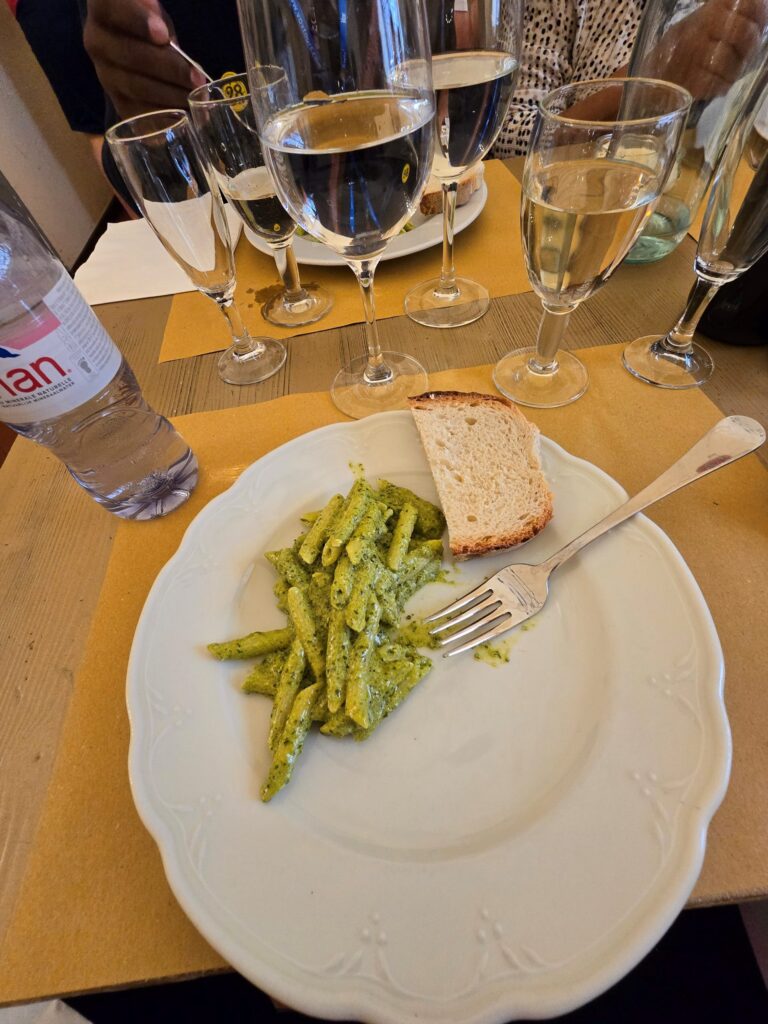 It was a “get to know you” type of lunch where the visitors filled in the open gaps in the table seating, figuring one seat was as good as the next. We didn’t know the people near us and we spent our half hour or so getting to know a little about them, a couple from Dallas. She was a teacher. We mostly talked about their degree of fondness for the Dallas Cowboys.
I mentioned that I’d spent some time in Dallas, including the site of the Kennedy Assassination. You know, normal chit-chat.
The pesto was delicious, though I wouldn’t say I would order it again. I would’ve preferred having a bit of a choice. Here I was in Italy and I hadn’t yet had a traditional Italian spaghetti-type meal. But when you’ve got lunch in front of you, you may as well make the best of it.
Hardly anyone was drinking the provided wine so I had a couple glasses just to make sure the whole thing didn’t go to waste. The wait staff was proficient but there wasn’t an opportunity to ask about them personally. It felt like eating in a nicely decorated cafeteria in Florence.
I described my lifelong mission to visit the David sculpture, but no one seemed particularly impressed. That’s it, then.
Since we were the last table to be served food, we had less time to consume it and relax. There was more than enough for everyone, but the meal, like the tour itself, felt rushed.
5. Florence artwork overwhelms, including its controversial subject-matter.
After the semi heavy meal, it was harder to go out and face the crowds once again.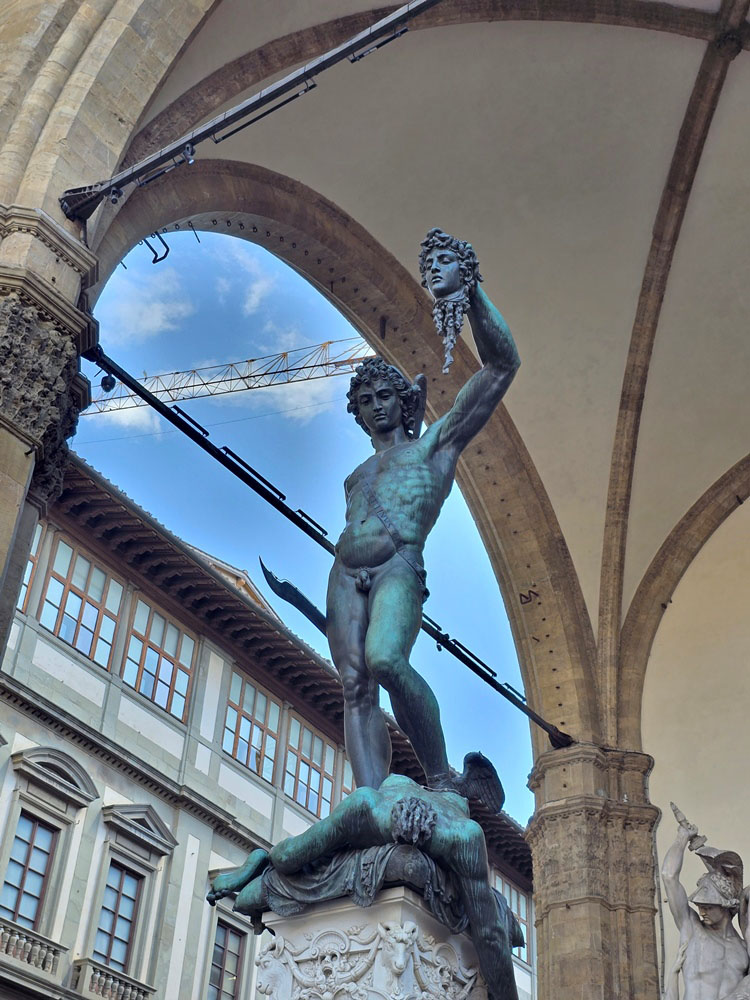
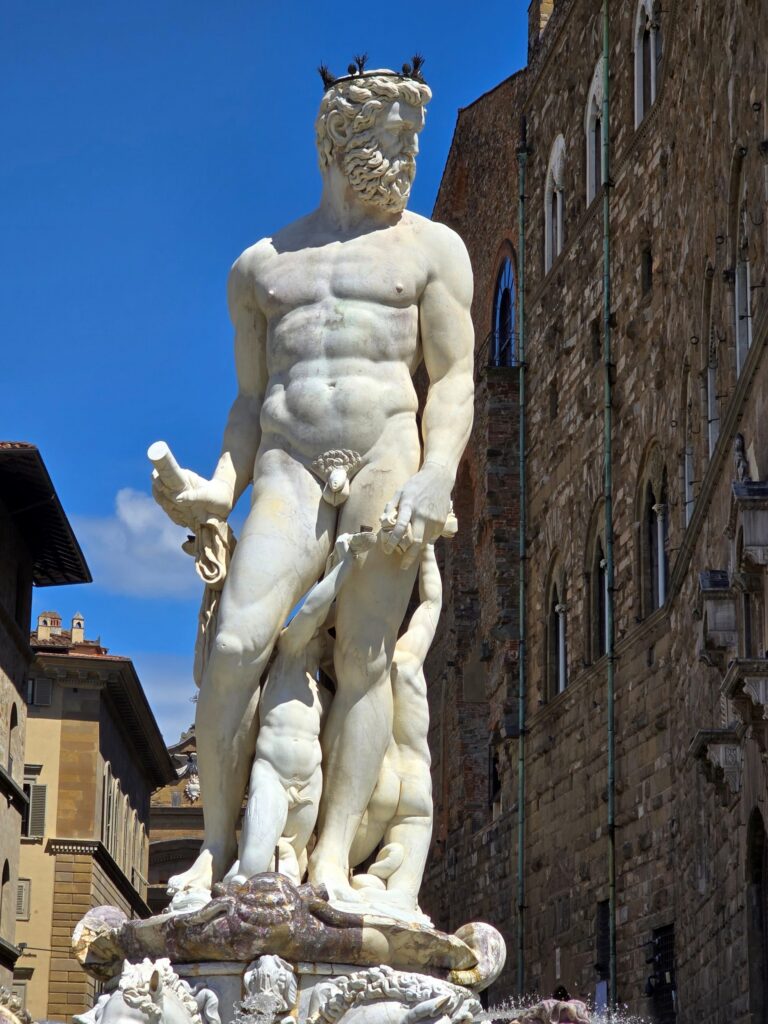
We were guided to the Piazza della Signoria, specifically to the statue of Perseus with the Head of Medusa under the Loggia dei Lanzi in Florence, a piece of work noteworthy for its shocking subject matter. There were other statues of anatomically gifted men in various poses, including a recreation of Michelangelo’s David and Donatello’s Judith and Holofernes.
It stands near other statues of men holding severed heads or representing power, such as Michelangelo’s David and Donatello’s Judith and Holofernes.
All of these works were commissioned by the powerful Medici family, whose name you see everywhere you step in Florence.
Those experienced with Renaissance art, and Florence, understand that much/most of it revolves around Biblical and Christian themes which dominate the subject matter. The Renaissance masters themselves were commissioned by individuals – like the Medici local rulers – to produce the works as part of an early but incredibly grand civic beautification project. The history is much too complex and detailed to relay here – or to fully grasp on an eight-hour tour of Florence like we had – but it’s enough to say that the leaders of the period were forward thinking men who didn’t mind spending money to make their surroundings appear as though they were fashioned in a dream.
Florence, as the Wikipedia blurb relayed, was also a political center and was the birthplace for a big chunk of modern political thought, particularly the musings of Niccolò Machiavelli whose observations in his work “The Prince” provided the basis for much of what political science students ingrained in their teeth-cutting years (at least that’s the way it used to be). Though it’s doubtful that tourists visit Florence because of Machiavelli, the man’s contributions are a key part of 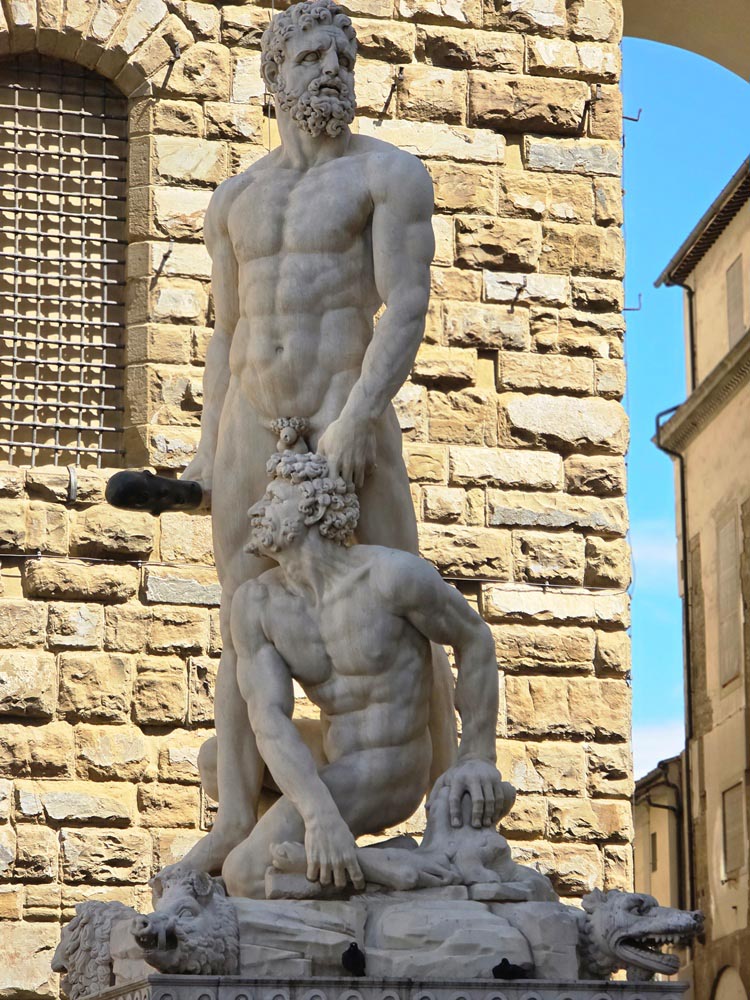 making the city’s reputation as strong and enduring as it remains today.
It shouldn’t be forgotten that, (from Wikipedia) “Machiavelli believed that public and private morality had to be understood as two different things in order to rule well. As a result, a ruler must be concerned not only with reputation, but also must be positively willing to act unscrupulously at the right times. Machiavelli believed that, for a ruler, it was better to be widely feared than to be greatly loved; a loved ruler retains authority by obligation, while a feared leader rules by fear of punishment.”
Perhaps this was the thinking behind the statues with gruesome severed heads. I wouldn’t know.
6. Easily the most disappointing tour segment of the entire Europe cruise
From there, a short distance away, was the famous Ponte Vecchio bridge.
From Wikipedia: “The Ponte Vecchio (Italian pronunciation: [ˈponte ˈvɛkkjo]; “Old Bridge”) is a medieval stone closed-spandrel segmental arch bridge over the Arno, in Florence, Italy. The only bridge in Florence spared from destruction during World War II, it is noted for the shops built along it; building shops on such bridges was once a common practice. Butchers, tanners, and farmers initially occupied the shops; the present tenants are jewellers, art dealers, and souvenir sellers. The Ponte Vecchio’s two neighbouring bridges are the Ponte Santa Trinita and the Ponte alle Grazie.”
We’d seen the Ponte Vecchio bridge on YouTube review-type videos, and it looked interesting, but like with everything else on this day, there wasn’t time to see it, though it was only a couple blocks away from us. We basically had a chance to take a few photos in front of the bridge and were beckoned to keep moving. Why, I wondered? What was next?
It was moving towards late afternoon and our guide led the group several more blocks to a busy, tourist-filled area, which was near the prominent church-like structure of the Basilica of Santa Croce. The building features a big Star of David (which was added between 1853 and 1863) on its facade, but it’s not a Jewish religious site.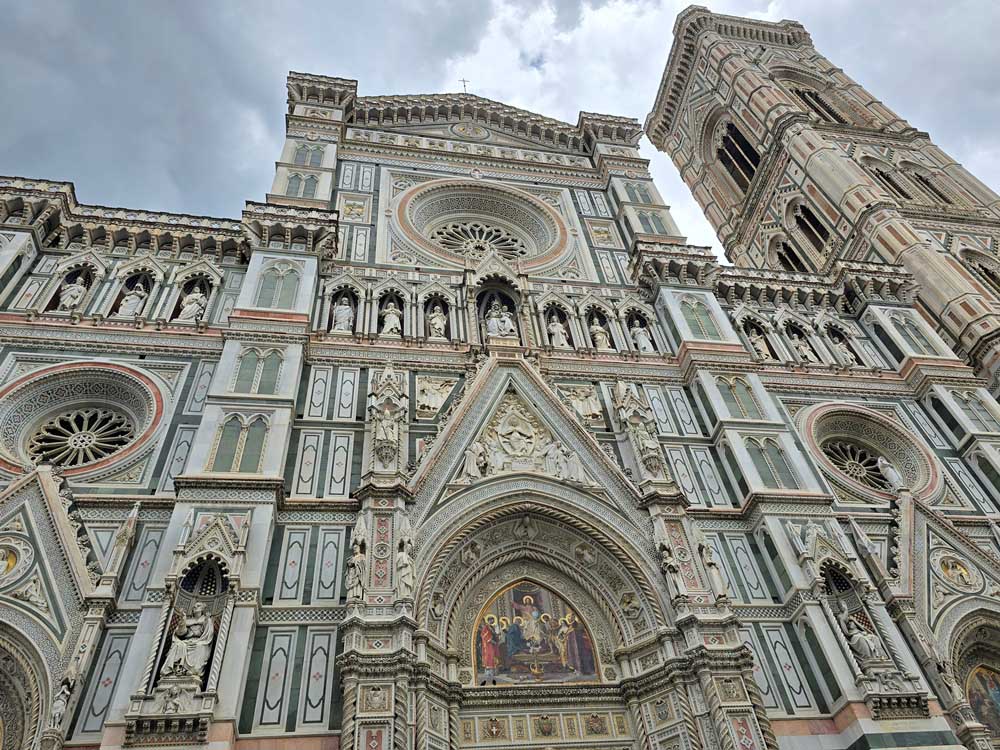
The building also contains a Chi-Rho (Christogram) symbol, suggesting a theological link between the Old and New Testaments.
But the Basilica of Santa Croce only served as a landmark for us, as we were guided to a shop (don’t remember the name) where we were instructed to sit tight because we were about to hear a presentation about one of the main industries of Florence.
We’d been told earlier about coupons and discounts and merchandise at a certain location. But I hadn’t thought much about it since I thought we’d be busy learning about Florence, the history and the ever-present artwork that’s everywhere in the historic birthplace of the High Renaissance.
We’d had the winery presentation a couple days previous on Mallorca, but it was part of the tour.
Instead, after a few minutes of standing around among high-end Italian merchandise, we were “treated” to a lengthy presentation about how great the handbags and jewelry was in this place, and how we would have a chance to purchase this and that at steep discounts we couldn’t find anywhere else.
 Say what? Why the heck were we wasting time listening to a sales presentation when we’re in Florence, Italy? I don’t know how others felt about the considerable detour from sanity we’d taken, but the pitch dragged on and on and on, and all I could think about was the opportunity we were missing to further explore Florence in the last hour or so we had to spend there?
I reasoned that the shop must give a kick-back to the tour operator to bring a captive tourist audience that was hungry for “bargains” they wouldn’t be able to get anywhere else.
Sure, it was nice stuff. We did end up peeking into a shop next door and checked into the price of a bracelet there, but it was $1200, so that was a little rich for us at that juncture. One note – when you return to the states, if you’ve purchased jewelry, you have to declare it in customs. Not a huge obstacle, but if you’re rushing to catch a connecting flight, the delay could be a deal breaker.
When the sales presentation finally concluded, we had about a half hour left of our allotted time until we needed to leave the area to locate the bus stage area, which was some distance from our shopping location. Perhaps this was part of the “shopping” portion of the excursion, but I can’t help but think the minutes and hours could’ve been better expended on the tour subjects in Florence.
The shops themselves were pretty standard tourist fare with local vendors. There were lots of little statuettes of David, shirts, shot glasses and, of course, mugs. The high-end jewelry and leather products in certain shops as well. Tempting as keepsakes, but you can only haul so much home on an airplane. Maybe that’s why they pushed the jewelry so hard.
At the appointed time we reconvened our tour group and the guide led us on a lengthy walk to the where the bus was waiting for us. I wouldn’t say any of the walk was particularly challenging – it was on flat streets, after all – but coming at the end of a long and hot day, it wasn’t something I’d choose to do if an alternative was presented.
Once on the bus, we were informed that the normally two-hour bus ride back to the port would be delayed – again – by traffic. No accident on the road this time, just lots and lots of cars. This was just the beginning of summer, too. A lot of American schools weren’t out yet.
The bus travel time would carry us past the ship’s “All aboard” time of 7 pm, but we were informed that the ship would wait for us and the other tour groups.
The same Tuscan scenery was available on the journey back, which seemed just as long as the ride into Florence.
Back aboard the ship, we’d missed our regular Main Dining Room time, so we didn’t have a chance to be served by our awesome server team of Vincent and Daniella. We were given a table with a Chinese woman server who was proficient but not overly helpful. We’d made requests and told we couldn’t substitute. There are benefits to having an experienced, regular waiter and assistant.
Previous articles from our Oasis of the Seas Mediterranean cruise:
European Cruise Destinations: Rome – Rome wasn’t built in a day; it can’t be toured in a day, either — https://www.golfintheusa.com/european-cruise-destinations-rome-rome-wasnt-built-in-a-day-it-cant-be-toured-in-a-day-either/
European Cruise Destinations: Naples — GolfintheUSA.com visits Pompeii (and Naples) – Amalfi Coast, Vesuvius and Sorrento https://www.golfintheusa.com/golfintheusa-com-visits-pompeii-and-naples-amalfi-coast-vesuvius-and-sorrento/
European Cruise Destinations: Barcelona – Drink in the sights, sounds, culture and history of the Sagrada Familia dominated Barcelona. Prepare to be wowed. — https://www.golfintheusa.com/european-cruise-destinations-barcelona-drink-in-the-sights-sounds-culture-and-history-of-the-sagrada-familia-dominated-barcelona-prepare-to-be-wowed/
European Cruise Destinations: Palma De Mallorca – The Island of Mallorca, breathtaking coastline views, great wine and a little history adds to the Spanish flavor — https://www.golfintheusa.com/european-cruise-destinations-palma-de-mallorca-the-island-of-mallorca-breathtaking-coastline-views-great-wine-and-a-little-history-adds-to-the-spanish-flavor/